

Today, there is a never ending stream of influencers who claim to have found the specific fund that will get you rich. At this point, I think you could find every single fund in the world recommended by at least one person on YouTube.
It’s not that they’re lying. Some of these funds have had amazing years. There’s almost always a positive thing you could find about them when you can pick and choose what to share and what to ignore.
The reality is that not all of these funds are equal in building reliable wealth. Any 30-second clip is going to lose a lot of nuance that matters.
In my last post, I talked about that framework and used it to evaluate ETFs aimed at generating additional income.
Today, I am going to do the same with the most commonly recommended ETFs for high-growth and big returns.
They fit into two main strategies. I’ll give a breakdown and verdict on each compared to our benchmark index funds over the last 10 years:
Sector and Industry Bets
Leveraged Sector Bets
The Framework: Risk vs. Return after taxes & fees
We look at ETF strategies for the goal of building long-term wealth over the next several decades.
These funds are marketed as the fastest way to multiply your money. But it’s not just the return number you have to know. Your framework should take into account:
How much taxes and fees eat up your return?
Can you survive bigger volatility, both financially and psychologically?
Is there a risk of losing all your money and being taken out of the investing game completely?
Can higher returns be counted on in the future?
Broad index funds: the gold standard
I’ve talked previously in my last post about why these index funds are the gold standard and why we use them as our benchmark for comparison.
They are highly diversified, ultra-low cost, tax efficient, and have generated healthy double digit returns in recent years and with drawdowns comparatively smaller than most other stock funds. The big three are:
Vanguard Total Stock Market (VTI) buys the whole US stock market and is my favorite fund.
Vanguard S&P 500 (VOO) buys just the largest 500 U.S. companies
Vanguard Total International (VXUS) buys the most important companies outside of the U.S.
VERDICT: Buy as much of VTI, VOO, VXUS as you can. Low fees, low tax drag, standard volatility while you get the expected return of the whole market. Hold these in any account you have: either in a taxable brokerage or a tax-advantaged account like a 401(k).
Sector and industry bets: trying to pick a winner
These funds narrow the market to a specific industry or slice. It could be a sector like tech, a theme like AI, or a single asset like bitcoin.
Instead of owning everything, you are betting on what part of the market you think will overperform the rest.
To be right, you have to know something the market doesn’t. Unfortunately, the market has orders of magnitude more data and information than any one of us. It’s already heard every story and theory you could think of. So unless you have some unique insight or information edge, it’s just a gamble.
If you’re wrong, concentrating in a narrow part of the market means you will lose more. That’s the biggest downside of these funds: higher volatility and risk than an index fund.
On the plus side, many of these funds tend to trade infrequently or pay little income, so their tax costs are reasonable. But fees can be higher, sometime significantly.
Let’s look at the three often recommended.
Invesco QQQ (QQQ) holds the 100 largest non-financial companies on the Nasdaq exchange, which is concentrated in big tech. These are companies like Apple, Nvidia, and Broadcom. They are big profitable companies that have had an amazing last decade of returns. QQQ returned 21.5% a year for a decade - although at the cost of higher volatility. Past performance is not a guarantee of future results, but these are all proven companies in established industries, which makes this fund less risky than some of the others in this group.
Global X Robotics & AI (BOTZ) focuses on artificial intelligence and robotics companies. While it includes high-performing tech companies like Nvidia, it also holds a large number of smaller automation companies that have struggled to grow. AI defined the last several years, and yet BOTZ returned 1.5% with higher fees. It underperformed in a time when it should be shining.
iShares Bitcoin Trust (IBIT) I originally wanted to focus on just stock funds, but I couldn’t ignore this Bitcoin ETF since this is so often recommended. If you bought Bitcoin ten years ago, you would have made a lot of money. Sure, everyone knows that. But Bitcoin, an asset with no earnings or cash flows underneath, is worth only the price the next buyer will pay. Will someone be willing to pay 10x for your Bitcoin in 10 years? Who knows. It has not been doing great this year and we’ve seen high volatility and risk in bitcoin so far in it’s short life.
VERDICT: Cap broader funds of more established companies, like QQQ, below 10% and more risky funds like BOTZ, and IBIT below 5% combined. These trade infrequently enough that taxes and account location isn’t really the issue here. The risk is concentration and volatility. You’re betting that you know something the market doesn’t, and the drawdowns run deeper if you get it wrong. Size any of these small enough that being wrong doesn’t significantly change your plan.
Leveraged industry bets: playing with fire
Leveraged funds borrow money to multiply an index’s return, often three times.
They usually run a daily schedule where they borrow in the morning, pay back the debt at night and repeat the next day.
When markets rise, daily compounding makes the returns enormous.
When markets fall, daily compounding makes it equally devastating.
The nature of resetting every day also creates some issues. Say you have a normal index fund and it falls 10% on Monday and rises 11.1% on Tuesday. You are now back to even. However, a leveraged 3x fund would fall 30%, then rise 33.3% in the same situation. The surprising math is that doesn’t bring you back to even! You are left with only 93.3 cents on the dollar. The index was flat after two days and you lost 6.7%.
Volatility alone is a drag on your growth.
A real crash is far worse. Run a 3x Nasdaq fund through 2000 to 2002 and simulations show a loss of over 99.9%. $100,000 investment would have been worth about $150. That’s a total loss.
Plus they also have the highest fees of any of the funds I’ve written about.
The most commonly recommended fund I see in this category is TQQQ.
ProShares UltraPro QQQ (TQQQ): This fund uses the 3x strategy on the same tech heavy investments of QQQ above. It generated a mind-blowing 43.6% a year for ten years. Granted, those 10 years were an incredibly good 10 years of investing in tech.
Its entire life since 2010 has been in relative good times. Yet, if you held it in 2022, you have lost 79%.
That loss would turn $100,000 into $21,000. Then getting back to even takes a 376% gain. Could you hold and not sell through that?
VERDICT: cap TQQQ and leveraged funds below 5%, and think hard about whether you want it at all. Daily resets mean volatility itself is a drag on your return, separate from whatever the underlying index does. The real risk is that TQQQ lost 79% in 2022 alone and would have been completely wiped out in a dot-com style bubble. (AI bubble anyone?) If you use these, invest an amount you could watch go to zero and be ok with it.
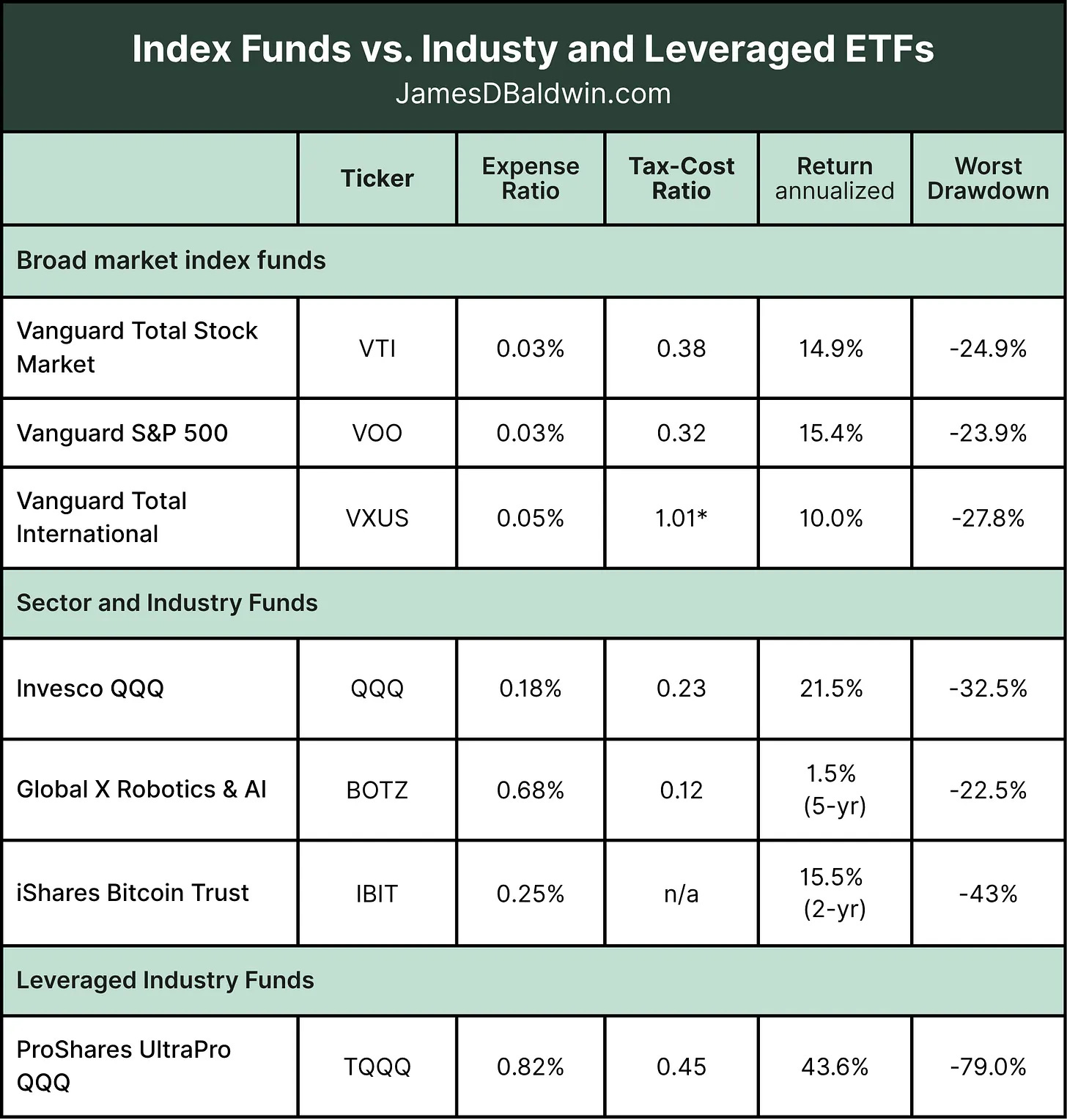
Looking back at all of these funds, the upside stories are impressive in some cases, but so are the drawdowns, and you only hear about the winners. There’s also no guarantee that any of these industries or set of companies will outperform in the future.
Chasing outsized returns is a fun challenge, but don’t make it your whole portfolio.
PS. Think an fund that pays regular income is a better choice instead of these high-risk funds? I broke down dividend funds and covered calls the same way here.
Leverage for the Long Run and Lifestyle Investing promote the use of leverage for investors with a long time horizon. Everybody points to the dot com crash to dismiss TQQQ but that ignores the impact of a DCA strategy and always assumes lump sum investment with only buy and hold and no risk management like annual rebalancing. Even QLD and SSO are 2x ETFs that can safely make up 20% of a diversified portfolio and get market beating returns for an investor with a long enough time horizon. You should go do some backtesting and get back to us, otherwise you are just peddling Boglehead mantras posing as wisdom.