

“Traditional retirement accounts are better than Roth the more you earn.” I’ve given that advice myself, and as a general rule, it still holds. You get the deduction now, at your highest marginal rate, and pay the tax later, in retirement, when your rate is usually lower.
But savvy readers will ask: “What about required minimum distributions (RMDs)? Don’t RMDs lead Roth to be better?”
They do, in some cases. Personal finance is personal. There are situations where RMDs can cause a problem worth planning around.
Let’s look at an example of a couple - Mark and Elena. They are approaching 40 and putting together a real financial plan for the first time. They’ve done the math and are on track to have $2 million between their 401(k)s and IRAs in retirement.
They’ve heard the phrase RMD “tax bomb” and want to know what to do about it. They expect to want to target an income of $125,000 in retirement and we’ll assume their portfolio is growing at 5% above inflation.
What is a Required Minimum Distribution (RMD)?
Once you hit age 75 (if you’re born 1960 or later), the IRS requires you to withdraw a percentage of your Traditional retirement account balance every year. The reason they do this is because Traditional Accounts have not been taxed, and the government doesn’t want you holding an untaxed account indefinitely. (RMDs do not apply to Roth accounts, which have already been taxed.)
The IRS publishes a table of how much you have to withdraw at each age. It is your account balance divided by a life expectancy factor. So the required distribution amount keeps climbing as you get older and your life expectancy gets lower.
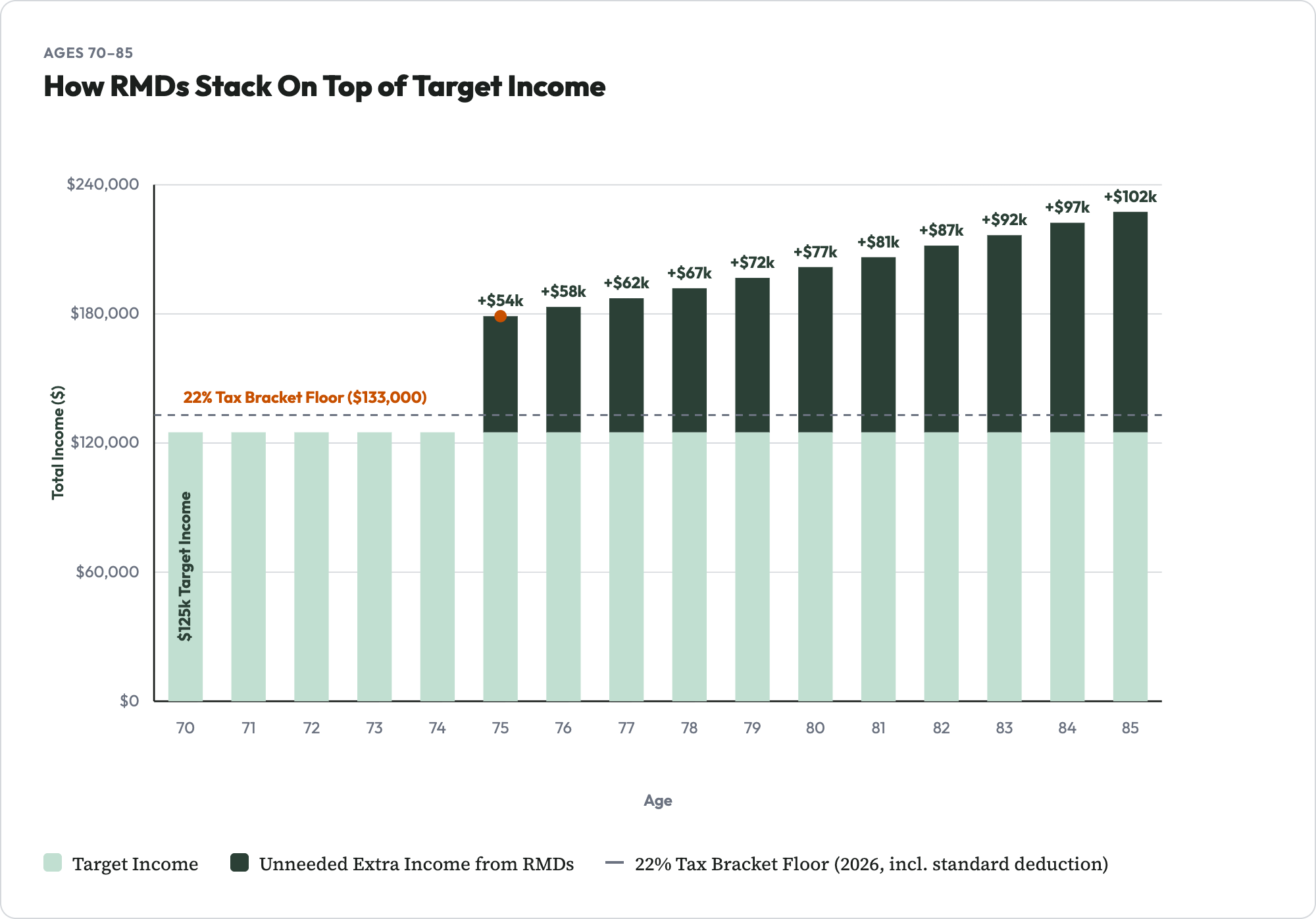
Let’s look at how this plays out with Mark and Elena.
They have $2 million at age 70, and they use a combination of 401(k) withdrawals and Social Security to fund their target income. This keeps them comfortably inside the 12% bracket.
Then age 75 arrives and RMDs start. The table requires them to withdraw 4.1%. That’s $94,300 or $54,000 more than they actually need that year.
By 85, the withdrawal amount has grown to 6.25% and they are withdrawing an extra $100,000 a year. They can reinvest the extra, but they can’t avoid the tax on it.
Now, this clearly puts them into a higher tax bracket. They’re now pushed into the 22% bracket, so all of that extra income is being taxed at a higher rate.
What is the RMD Tax Torpedo?
But there’s another big tax implication of this, which is colorfully called a “tax torpedo”.
It is the impact on how Social Security is taxed. Social Security isn’t taxed with marginal tax brackets like most income. Instead, there is a formula for calculating how much of your Social Security can be taxed at all, based on how much total income you have. The more you make, the larger the proportion of your total security check is taxed - up to 85% of your Social Security.
When Mark and Elena were just withdrawing what they need before RMDs only 45% of their Social Security was taxed. The remaining 55% was withdrawn tax-free.
When RMD started, they got torpedoed, and now the full maximum amount, 85% of their Social Security, is taxed.
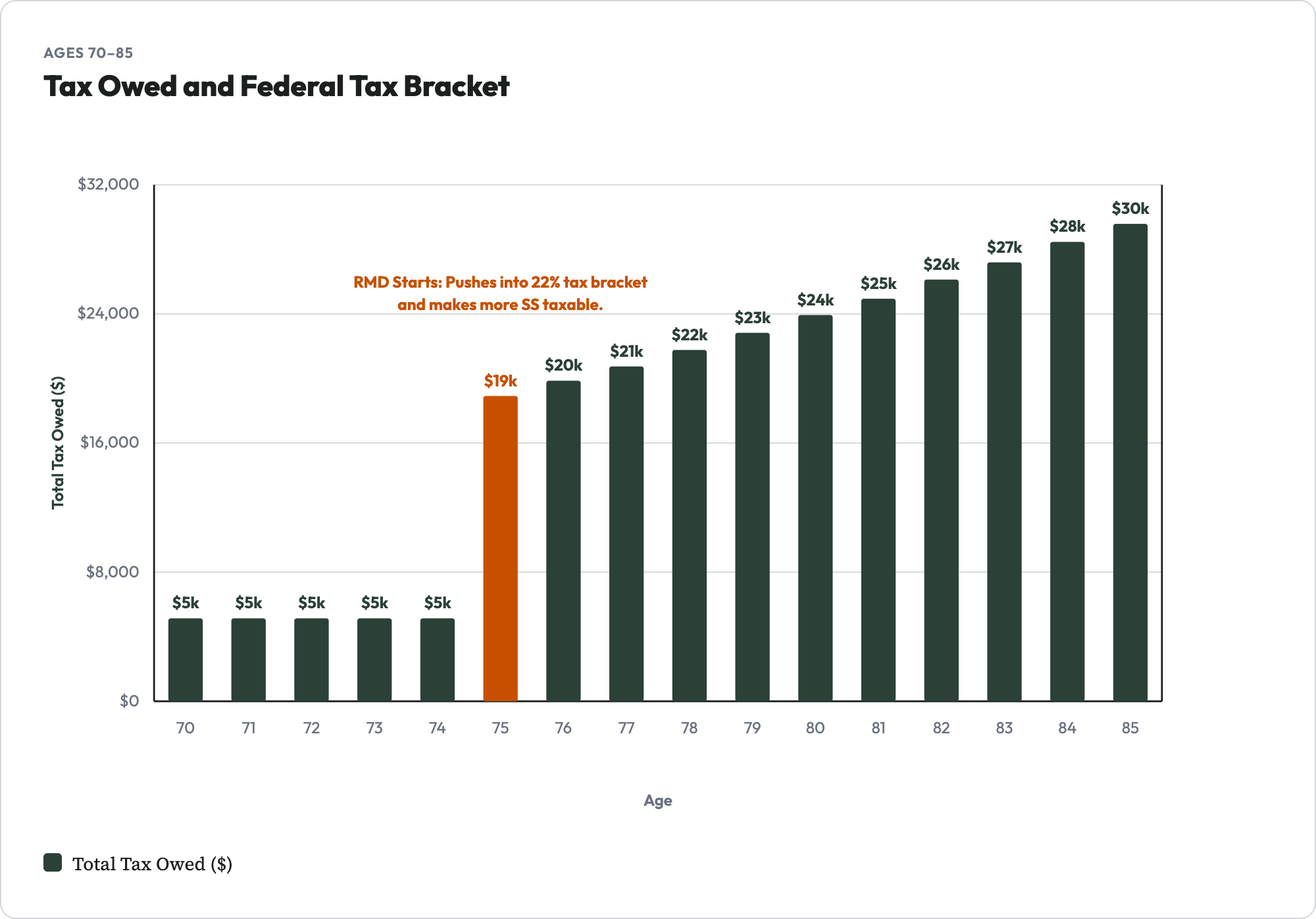
Same assumptions as above. Federal tax owed by age, current-year brackets, no state tax included.
For Mark and Elena, taxable income jumps from about $47,000 to $134,000 in a single year. Federal tax nearly quadruples, from $5,000 to nearly $19,000, and it keeps climbing every year due to the combined impact of higher withdrawals at 22% tax bracket and the larger amount of Social Security that is taxed.
That adds up to an extra $210,000 in taxes over 10 years.
Should everyone be afraid of RMDs?
Mark and Elena are representative of people who have good jobs, have been preparing for retirement, and will have amassed a good-sized nest egg.
In their case, RMDs almost quadruple their taxes and are absolutely worth planning around.
But for more typical retirement account balances, the fear is overblown. The median portfolio at age 65 in America is around $400,000. At that level, RMDs are not an issue. They’re not going to push you into a higher tax bracket or dramatically change the amount of Social Security that’s taxable.
The cutoff where it starts to matter is somewhere in the range of $1 million and $1.5 million in Traditional retirement accounts. So it only matters if you have a good income and are a diligent saver.
If you live in a high tax state like California or New York? The conclusion doesn’t change, the numbers just run a little bigger.
The Verdict
If your Traditional balance is on pace to exceed $1.5 million by the time RMDs start, the tax bomb talk isn’t hype, it’s worth planning around.
If you expect to be a lot less than that, you don’t need to change your plan.
If you do think you’ll be above $1.5 million, it doesn’t necessarily mean that a Traditional 401(k) is the wrong call. It’s still often right for high earners, because there are other ways to get around the RMD problem.
Roth conversions in the years before RMDs start, qualified charitable distributions once you’re eligible, and a few other moves can often mitigate the issue considerably - particularly if you retire a little early. I’ll talk about each of these in a future post.
I encourage you to check if RMDs will be a problem right now - pull your current traditional balance across every 401(k) and IRA you hold. Use this calculator to project it forward. If your Traditional portfolio is projected to be above $1.5 million, you may have a problem. Stay tuned, and I’ll help you understand the options to solve it.