

Welcome to our new readers! This is an update to the piece I published this time last year, using current market conditions and newly released data to revisit the big question on everyone’s mind: “Is the stock market in a bubble? And what should I do about it?”
How high is the stock market, historically speaking (2026 update)?
The market continues to show some intimidatingly high valuations.
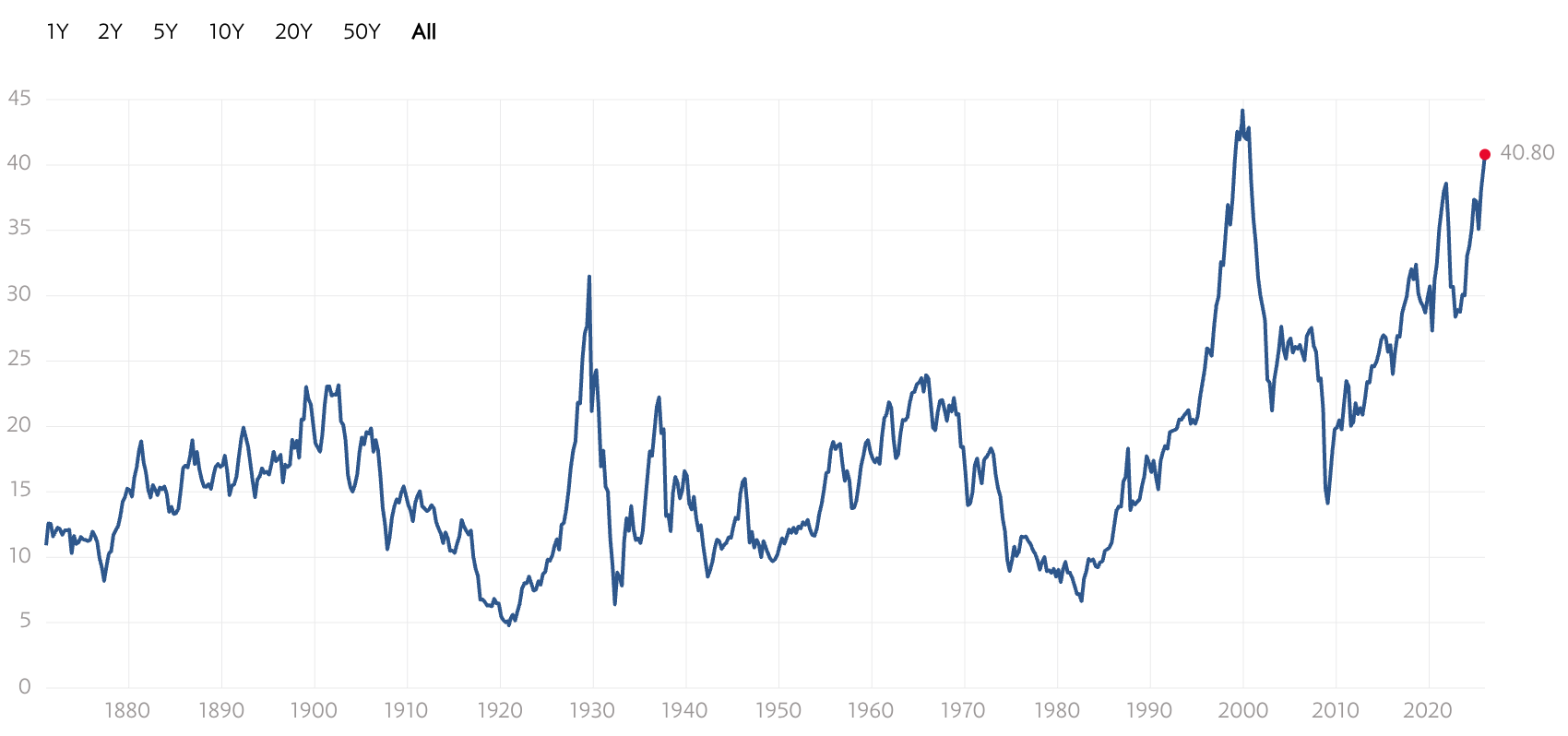
Let’s take an updated look at the S&P 500 CAPE ratio, a classic measure of valuations.
As of January 2026, the CAPE ratio is indeed historically high. The only time we’ve seen higher valuations was right before the dot-com bubble burst.
So, what do we know about what tends to follow high valuations?
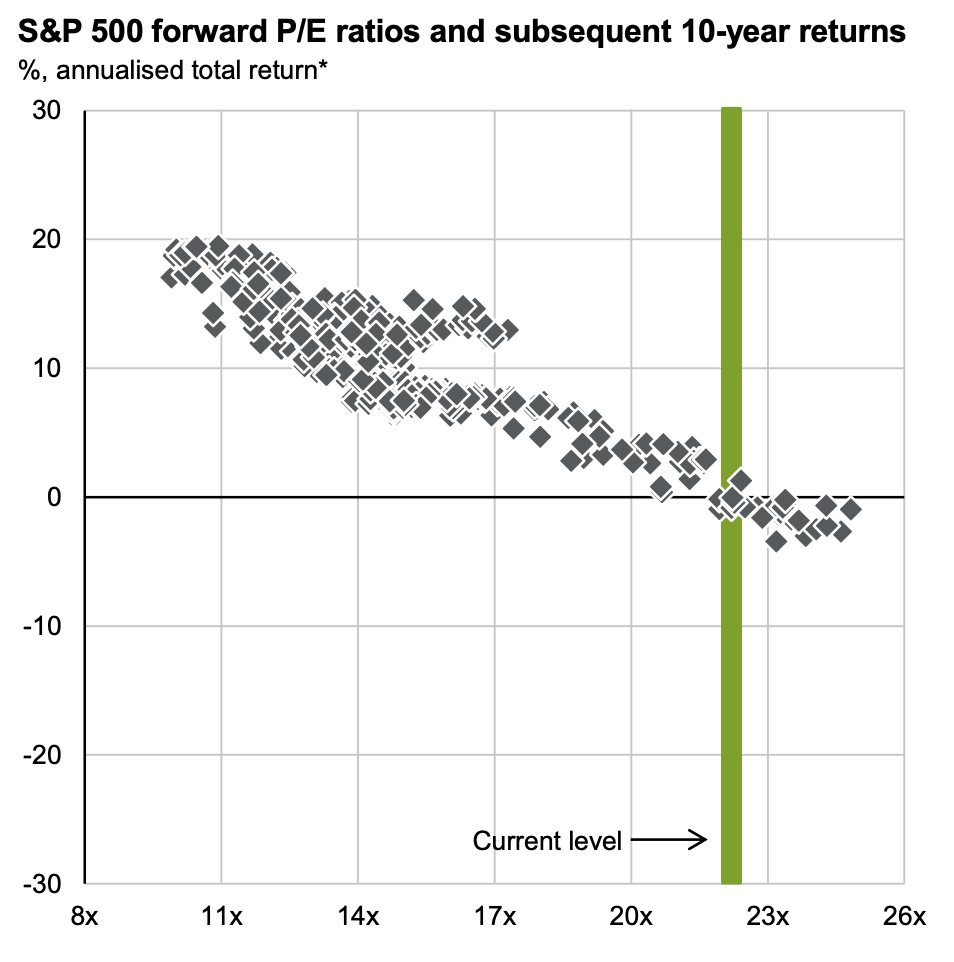
When valuations are this high, returns over the following 10-years have been terrible.
Here is the same chart from JP Morgan that we looked at last year, updated at the start of 2026. We see a clear trend of higher starting valuations translating into lower 10-year returns.
Today’s level at the start of 2026 is highlighted with the vertical bar. Historically, we have seen low single-digit positive or even negative returns over the 10 years following similar market conditions.
Of course, that’s just what has happened in the past. We know that past performance is not indicative of future results. But it certainly is a concerning pattern.
What about the short term? Should we be bracing for a crash?
Now, look at the 1-year returns from JP Morgan’s research updated at the start of 2026.
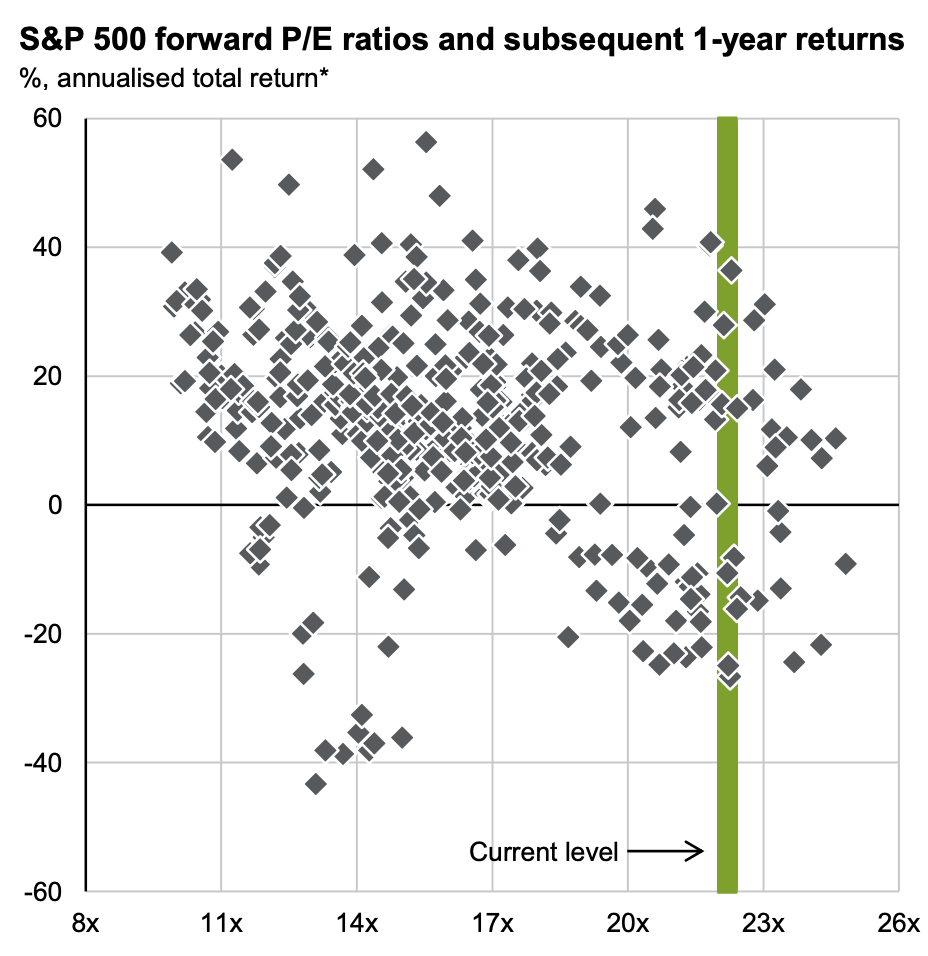
There’s no pattern here at all.
Valuations tell us very little about what happens next year. Even at high starting valuations, one-year returns have ranged from deep losses to gains over +40%.
In 2025, investors who waited for prices to fall missed a +17.9% return. No Wall Street bank predicted a return that high.
That’s not surprising because the one-year return is always unpredictable.
High valuations point to muted long-term returns, but they offer no help in timing the market.
Are these high prices justified or are we in a bubble?
As we discussed a year ago, it comes down to earnings per share growth (EPS).
The bull case: Many analysts are penciling in low-to-mid teens earnings per share growth for 2026. The Fed has cut rates from the peak, which helps justify paying more for future cash flows. Optimists are still betting on productivity gains from AI and continued profit growth.
But the bear case is also basically unchanged. When valuations are elevated, there’s little margin for error. A small earnings miss or slower-than-expected AI productivity gains can quickly weigh on prices. And with so much market leadership concentrated in the biggest tech names, sentiment can swing fast.
There is still a reasonable case that stocks are not overvalued if earnings keep growing as they did in 2025, but high valuations are fragile and difficult to sustain.
What’s a wise investor to do?
The lesson from 2025 and the JP Morgan analysis is that the stock market is unpredictable in the short term but tends to follow long-term patterns. This matches everything we know about the stock market.
Historically, investors have been rewarded for staying invested, even during periods like today, because:
We never know when the market will turn. It could take years.
Once you get out of the market, it’s hard to know when to get back in. How much would valuations have to go down to start investing again?
We might have another great year before a downturn, just like we did in 2025. Or the market could drop tomorrow. No one can predict it. Be skeptical of anyone who says otherwise.
I still have 4 recommendations for investors today.
1. Follow your timelines, ignore the headlines.
Keep investing based on your financial plan and retirement timelines. We know that the stock market tends to go up in the long-term, even if they can be extremely volatile in the short-term.
Timelines and goals should always guide your strategy, not what the market does on any given day.
2. Work on your financial plan.
If you haven’t thought about it in a while, now is probably a good time to update your financial plan with an asset allocation that matches your goals and timelines.
For example, are you 100% in an S&P 500 index fund? That’s a pretty good general-purpose strategy, but only if your timelines are long and can handle the volatility.
But what if you are about to start a family? Or buy a house? Take a career risk? Those need a different plan. If you don’t know where to start follow my 10-Steps to Building Life Changing Wealth.
3. Adjust your expectations.
Markets don’t consistently deliver double-digit growth over the medium term and are unlikely to provide anything close to that when valuations are so high.
This probably won’t be the decade where you get rich.
If you are counting on 12% annual returns to retire 3 years from now, it’s probably time to review your planning assumptions and take some risk off the table.
4. Stay diversified.
Just as we can’t predict one-year returns on the total stock market, we can’t expect to pick the winners and losers of individual stocks and sectors. That’s why my favorite fund is fully diversified.
Keep investing. Spread out your risk. Ensure you have the right asset classes in the right proportions to match your goals and timelines.
Disclaimer: This article is for general education only. It isn’t personal financial advice. I don’t know your whole situation, goals, or risk tolerance, and nothing here should guide your decisions on its own. Do your own research or speak with a professional before acting on any investment ideas.
Didn't expect such a clear and concise update on market valuations, your analysis of the CAPE ratio is truely insightful. What if the unprecedented rate of technological advancement, especially in AI, acts as a long-term disrupter to these historical patterns, allowing for sustained growth even with high starting valuations?
Excellent, rational analysis of where we find ourselves today. The four recommendations are perfect for any investor. Thank you for presenting this calm, realistic and actionable take.