

“What else should I be doing with my money? Am I missing something?”
I get this question all the time, and I love it. Because the answer is almost always yes, usually in a part of your money that wasn’t even on your radar.
Most money advice online is some version of the same two things: budgeting tips, or stock tips. That’s only a sliver of two of the five jobs your money actually has.
Here are all five:
Fuel it: Pay yourself first
Multiply it: Compound your wealth
Keep it: Stop bleeding taxes and fees
Protect it: Forge your financial armor
Live it: Fund what really matters
This article gives you the whole map of money management. So the next time you hit a piece of advice or a new strategy, you’ll know how it fits in and whether it serves you.

Fuel it: Pay yourself first
“The first $100,000 is a bitch, but you gotta do it.”
— Charlie Munger, business partner to Warren Buffett
He was right. It’s the hardest money you’ll ever build, because at that size the pile is too small for compounding to do the work. It’s all you.
Many of you have already cleared this, so I’ll keep this section short.
Sadly, this is the job where most money advice gets stuck: Make your coffee at home. Pack your lunch. Clip the coupon.
It’s a necessary step. You need savings to fuel the other four jobs.
Saving is like pouring water into a bucket. You want to fill it. You pour water in (income) but there are holes in bottom leaking it out (your spending).
Wealth is what stays in the bucket.
Most people get a raise and immediately add more holes to the bucket. It never fills any faster.
But you can sidestep this with a clever trick: add a second bucket that doesn’t leak.
That’s your savings. Pour your money into this sealed bucket first. Before it has a chance to leak out of the other bucket.
The more you pour into this sealed bucket of your savings, the higher your savings rate.
The higher your savings rate, the more you can invest and multiply your money in the next step, where things get interesting.
Multiply it: Compound your wealth
An ambitious young kid started earning money with a paper route. By hustling and taking every opportunity he could find, he saved up $5,000 as a teenager. He decided to invest it. He was a quick learner, and by age 30 his investments had grown to $1M. By 45 they had grown to an incredible $20M.
If he had stopped there, no one would have ever heard of him. He’s now worth over $100 billion at age 95. His name is Warren Buffett.
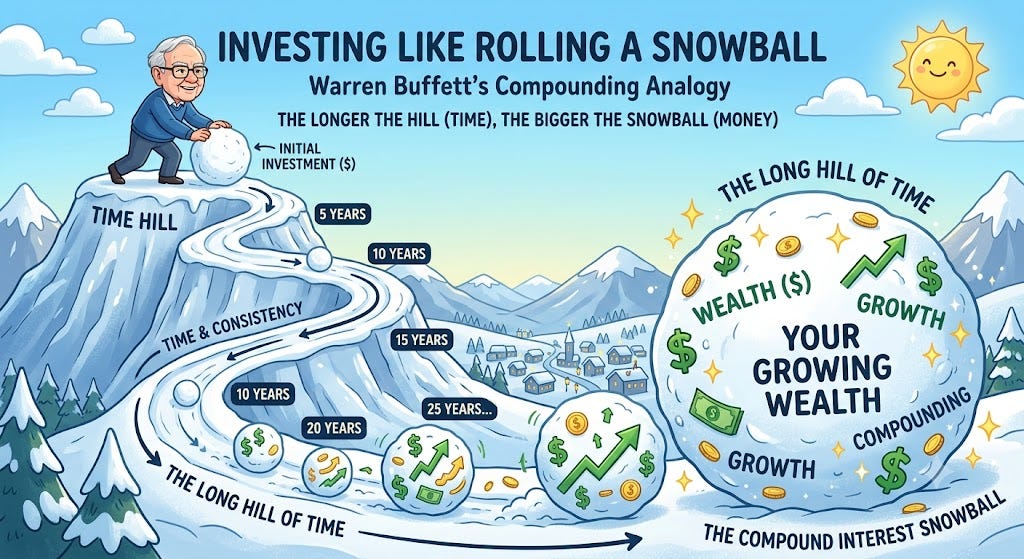
Buffett likes to talk about investment compounding like a snowball. “The important thing is finding wet snow and a really long hill.” The longer the hill, the bigger the snowball.
His own story shows the biggest gains come the longer you wait. Compounding takes time.
That’s why over 96% of Buffett’s net worth came after age 65.
The dollar amounts are smaller for the rest of us, but the principle holds. Most of your investment gains happen toward the end of your timeline.
That makes investing more a game of patience than of picking what to buy. Low-cost ETFs and index funds have made it easy to own a slice of nearly every successful company in the world.
“The stock market is a device for transferring money from the impatient to the patient.”
— Warren Buffett
If you can invest with patience, great things can happen. Take Netflix.
Imagine you had invested $27 in Netflix every month (the cost of today’s subscription) starting when they launched streaming in 2007. How much would that be worth?
You would have put in about $6,000 over those 19 years.
It would be worth over $300,000 as of early 2026, with more than half of that growth in the last 3 years.
Once you hit that stage, you’re generating enough wealth to change your life: to buy back your time, travel the world, or live however you choose.
But there are two forces working against you every year, trying to eat into the magic of compounding.
Keep it: Stop bleeding taxes and fees
A casino house edge is surprisingly small. It’s only a couple of percentage points.
Take roulette. The wheel has thirty-eight numbers, and the house only wins on two of them (the zero and double-zero). That’s a 5% edge. Blackjack is even lower, at around 1.5%.
That doesn’t sound like much. And yet it’s made Las Vegas filthy rich with casinos like these:


Those small percentages add up fast when they’re taken over and over again. John Bogle called them “the tyranny of compounding costs.”
In managing your money, you have to face the house and its compounding costs on two fronts: Wall Street and taxes.
House #1: Wall Street
Wall Street has run a wildly successful industry for a long time because many people turned to them to manage their money. It’s understandable. Wealth and investing strategies are complex. Getting things wrong can have huge consequences. So people turn to an expert financial advisor like they would an expert plumber.
But these industries are totally different, and the advisor industry has figured out a way to charge you that’s much more insidious.
You pay a plumber $250 to fix your toilet, and you’re done. Not the advisor. They charge 1% of your portfolio every year, for life. And because it’s pulled straight from your account, you never feel it leave.
That would be bad enough if it were the only cost, but there is another.
Investing in a fund also has fees. Choose a bad one and it could add another 1% per year.
So now you could be paying 2% every year just to stay invested.
How bad is that? Let’s look at the impact on your wealth, using $100,000 invested with and without a combined 2% fees.
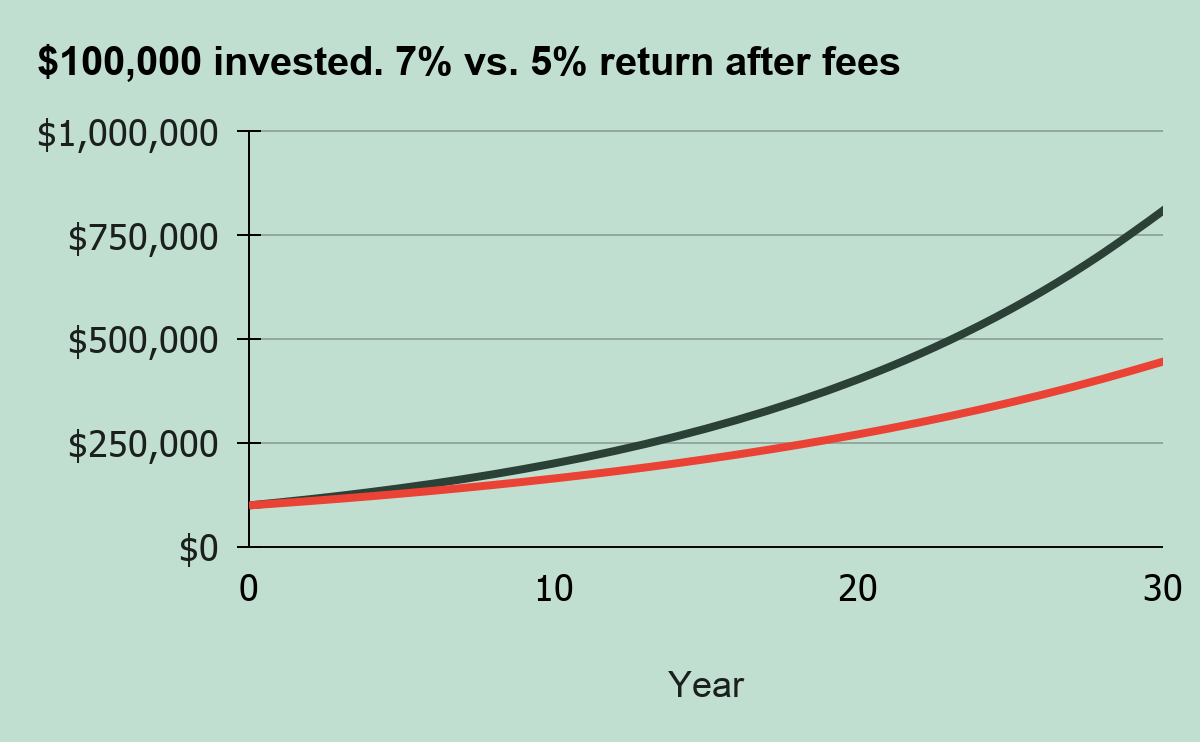
The portfolio without fees grew to $810,000.
The portfolio with a 1% advisor plus 1% fund fees grew to $445,000. Fees cost you $365,000.
The house just took nearly half your money.
In the old days, there wasn’t really an alternative to paying these high fees. Thankfully, John Bogle came along and launched the first retail index fund at Vanguard.
Today, you can skip the exorbitant costs of a traditional advisor and simply buy high-quality investments at fees that are close to zero. For example, like my favorite fund here.
House #2: Taxes
Taxes and fees are the same kind of enemy: small, repeated, and taken off the top.
Taxes can show up all over the place, from dividends, to stock trading, to misusing 401(k)s. For example, the tax drag on holding a bond fund in a taxable account can get close to 2% for people in high tax brackets. You saw above how much a compounding cost of 2% can be.
Thankfully, both taxes and fees are largely in your control. Fees you cut once. Taxes you manage every year. As you get further along in your wealth journey, taxes become the place where you can have the biggest impact on your wealth, particularly once you’ve accumulated six figures.
But these aren’t the only threats to your wealth. You also have to contend with the risks you pose to yourself.
Protect it: Forge your financial armor

Few know the story of Rick Guerin.
But many know the story of his former partners Warren Buffett and Charlie Munger.
Buffett and Munger became billionaires investing with Berkshire Hathaway. Rick was there in the beginning and was on the path to join them.
But Rick wanted to get rich quickly. So he took out debt to invest more. Then the 1970s recession hit. With stock prices declining and without enough cash, he was forced to sell virtually all of his Berkshire Hathaway stock.
At that point Buffett bought his stock from him for $40 per share. Today it’s worth over $700,000 per share. Rick lost billions.
When you think about risk, you often think about stock market crashes and recessions. But it wasn’t the recession that ruined Rick. Plenty of investors, like Warren, survived the terrible market of the 1970s.
The leverage ruined him. A major setback for Buffett became a catastrophe for Rick because of the choices he made leading up to that point.
He didn’t have any financial armor.
You need that armor most when faced with the risk of big losses.
Imagine you just lost 50% of your money, dropping from $100,000 to $50,000 on a bad investment.
You want to earn it back. But the math just got a lot worse. Now you have to generate a 100% return just to get back to where you started.
The market can knock you down, but it’s often your own choices that do the most damage, like:
Being forced to sell your investments to cover a debt or a cash need.
Panicking at the bottom and selling right before the market rebounds.
Holding all your money in cash, waiting for a dip that never comes, and missing a big rally.
It’s not enough to let compounding do its work. You have to build the armor that keeps it from being interrupted, so the snowball keeps rolling.
That armor can also help you stop worrying and start living. A bigger, ever-growing portfolio isn’t the end goal. It’s what that money allows you to do.
Live it: Fund what really matters
A year ago, my neighbor Alan quit his job and took his family of four on a year-long round-the-world trip.
The first stop was his home country: Korea. His two pre-teen kids enrolled in school there, polishing up their Korean, making friends, and getting to know aunts and uncles on the weekends.
When the semester ended, they moved on and started worldschooling. They went to Cambodia, the Great Barrier Reef, and finished with a month in the French countryside. They’re now home with experiences and memories the whole family will never forget.
Stories like Alan’s are inspiring. They show what’s possible when you make a plan, fund it, and don’t wait until it’s too late.
Putting your money to work through the other four jobs is what lets you live the life you want.
What makes a life feel full is different for each of us, and figuring out your own version is the work of a lifetime.
Yet many of us neglect this. The most common regret of the dying is wishing they had the courage to live a life true to themselves, not the life others expected of them.
Starting to invest early is important, and you also have to pay attention to the more important things in life.
I remind myself, that’s not why I’m doing this. It’s not about keeping score.
It’s about having a vision for the life I want to build, saving enough to fund it, and having the courage to live it before it’s too late. Too many of us get taken before we can live out our goals.
Which reminds me of a story that Kurt Vonnegut told about his friend Joseph Heller, author of Catch-22.
The two were at a party thrown by a billionaire. Vonnegut turned to his friend and asked, “Joe, how does it make you feel to know that our host only yesterday may have made more money than Catch-22 has earned in its entire history?”
And Joe said, “I’ve got something he can never have.”
“What could that possibly be?”
“Enough.”