

In this post last month, I explained why a Traditional 401(k) is still usually the right call for high earners, even when RMDs could pose a tax problem later.
That’s because Required Minimum Distributions (RMDs) are a fixable problem, primarily through a strategy called Roth conversions.
Even if you are nowhere near retirement age (like me), understanding this strategy will help you build a stronger financial plan that will allow you to retire sooner.
Let’s return to the couple we met dealing with this challenge. Mark and Elena are on track for $2 million in Traditional accounts by age 70. Once RMDs start at 75, the IRS forces them to take more than they need, and they pay almost four times as much taxes.
Those extra taxes hurt. They have big plans for using that money to enjoy their life. They'd prefer to upgrade their travel, give more to charity, and have more to leave behind to their family.
They start to investigate Roth conversions to lower their tax bill.
What is a Roth conversion?
A Roth conversion moves money from a pre-tax account, like a Traditional 401(k) or IRA, into a Roth IRA.
You much pay income tax now on the conversion. In return you get tax-free growth and immunity from future RMDs. (As a reminder, RMDs are withdrawals that the IRS forces you to take from your Traditional 401ks and IRA starting at age 73 or 75 so they can tax that money.)
It’s a tradeoff that makes sense when your marginal tax rate on Roth conversions is lower than your expected future tax rate.
You are strategically paying less taxes now to save more later.
The problem is lumpy income
In Mark and Elena’s original plan without conversions, Social Security starts at 70 and then RMDs start at 75 for them. The RMDs stack on top of Social Security, well past what they need to spend. That extra spills over the 12% tax bracket into the 22% bracket. They are forced to pay higher taxes in later retirement.
Then, Mark and Elena notice that their taxable income is close to zero from 65 to 69. They’re living on savings and investments that were already taxed, so the low brackets sit nearly empty.
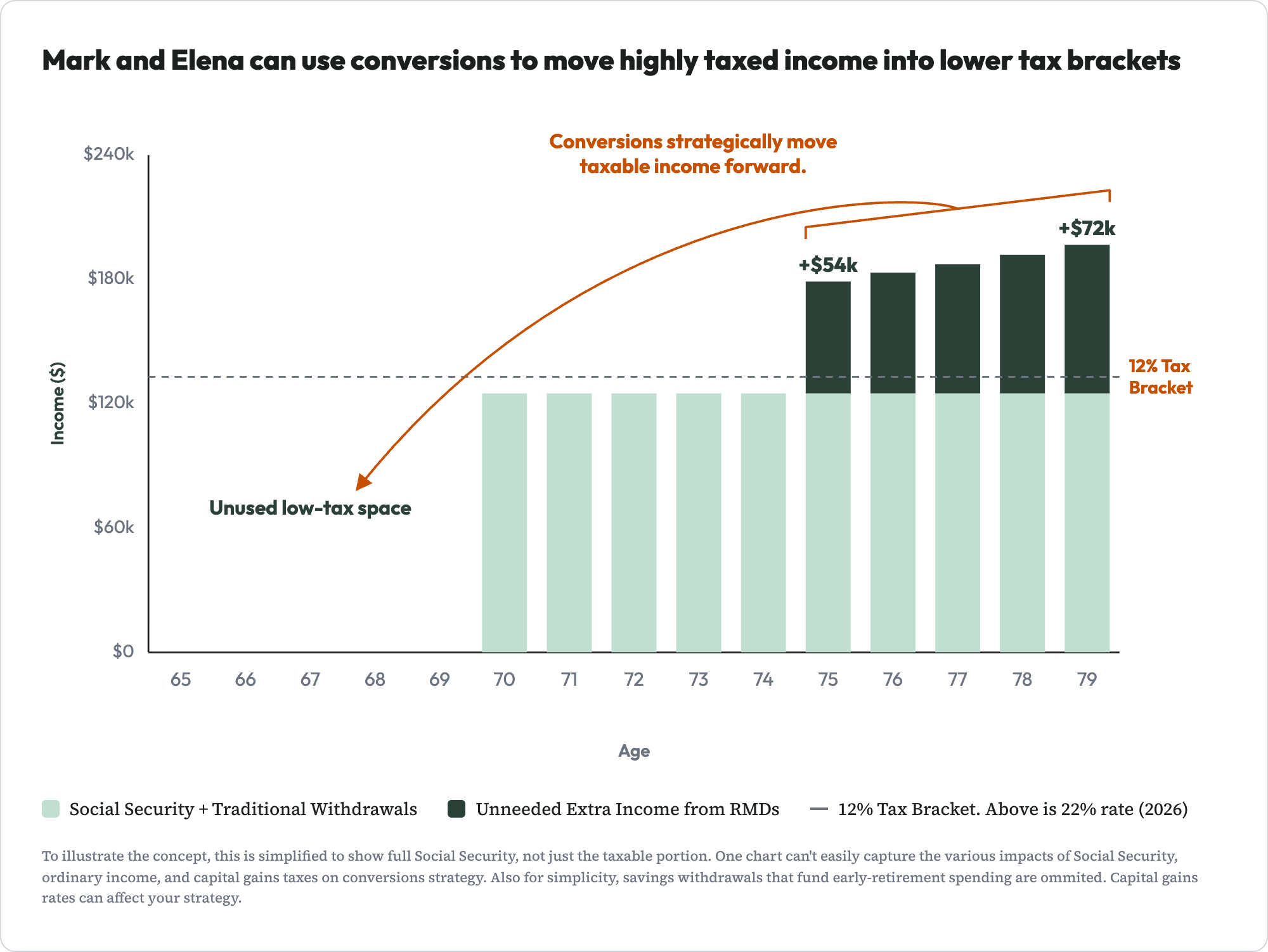
The fix: fill the empty years
They can use a Roth conversion strategy called bracket filling to use up all of the low tax-bracket space.
Bracket filling: Each year, you convert just enough to reach the top of your target tax bracket, and nothing more.
For Mark and Elena, that means converting their Traditional 401(k) to a Roth in the amount that fills the 12% bracket every year from 65 to 69.
They pay the lower tax now instead of the higher 22% tax later.
Although they are filling to the top of the 12% bracket, remember that they also benefit from the standard deduction and also the lower 10% bracket for part of the conversion.
Which means it costs them less than 9 cents in federal tax per dollar converted. Compare that to 22 cents they would have paid on RMDs later.
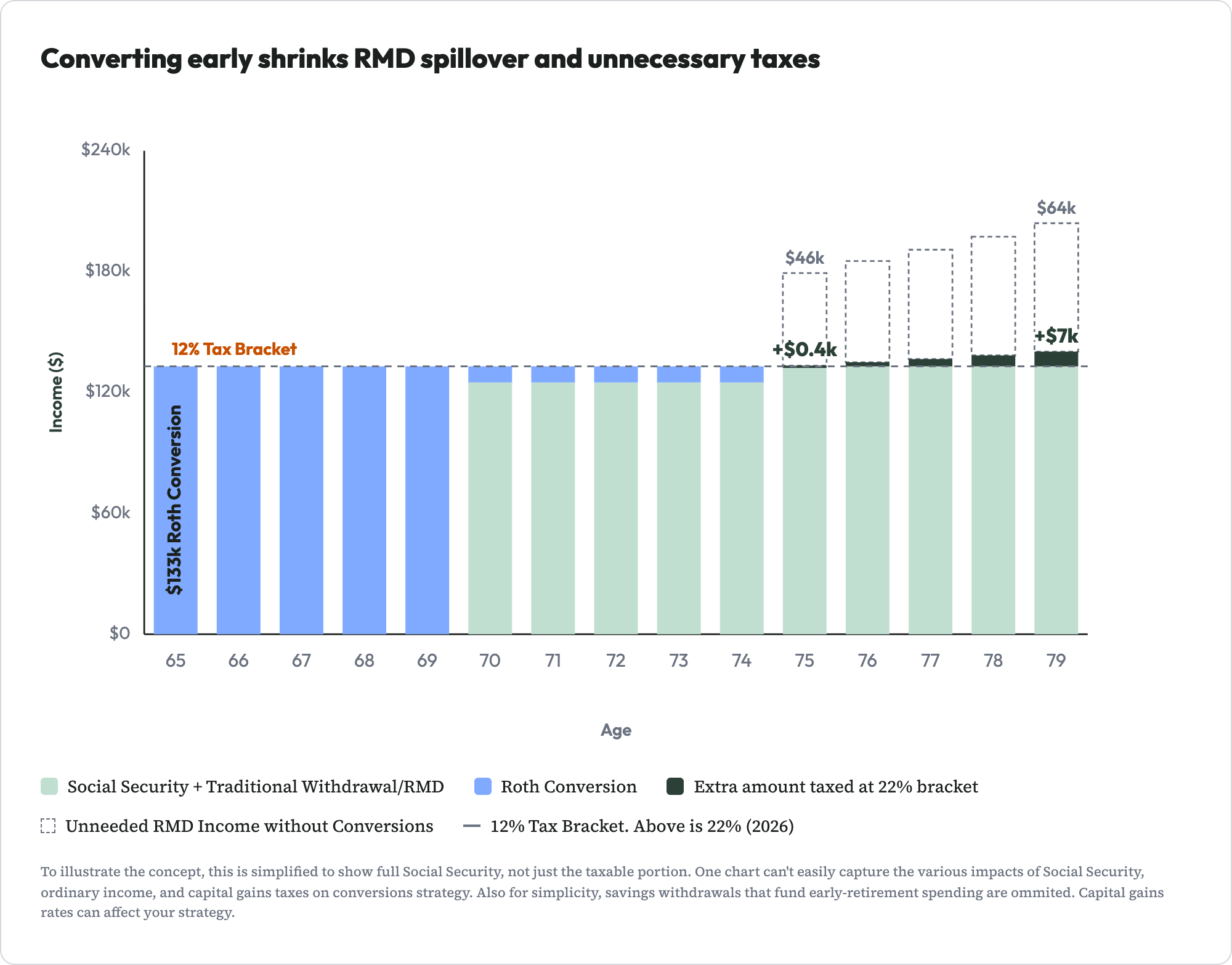
Most of the RMD problem that’s pushing extra income into the 22% bracket is gone, and their RMDs are small and managable.
Due to this strategy, they save over $70,000 in federal taxes and come out $138,000 richer on a tax-adjusted basis.
They have the added benefit of more money in a Roth account they can now use to manage their tax rates, pass on to their family tax-free, and avoid Medicare surcharges.
Who should consider this?
The rule of thumb from my last post still applies: a Traditional balance on track to pass roughly $1.5 million by the time RMDs start. If you have this much or more in your Traditional accounts, it pays to analyze your conversion strategy.
You also need low-income years before Social Security or RMDs begin. If you don’t have low-income years, there are other options like giving your RMDs directly to charity through Qualified Charitable Distributions (QCDs.) I will cover these in the future.
Common mistakes and what to look out for:
We didn’t model everything with Mark and Elena, and there are a few other things to watch out for:
Don’t ignore capital gains and Social Security taxes. Conversions can push up how much Social Security is taxed and push capital gains into higher rates.
Make sure you account for Medicare premiums. Medicare charges higher premiums (IRMAA) above certain income levels, which can be affected by conversions.
Don’t pay tax out of the conversion itself, if possible. Withholding the tax from the conversion means less is converted into the Roth. Instead, use other savings to pay the tax.
You can’t undo it. The 2017 tax law ended the ability to reverse a conversion. It’s permanent, so make sure you are confident in your strategy.
The Verdict
If your Traditional balance is headed above $1.5 million and you’ll have a gap between retiring and claiming Social Security, filling the low brackets in those years can save you a lot of money. It can help you build more wealth that you can use however you like, whether it be to upgrade to business class, retire earlier, or be able to give more generously.
Once Social Security starts, that window mostly closes. So plan ahead.
If you think this applies to you, here’s where you can start:
Map your gap years. The years between when you stop working and when you claim Social Security. These are your conversion window.
Run the numbers before your first conversion. It can’t be undone, so calculate each conversion deliberately and get help if you need it.
Coming soon: Should you contribute to a Traditional or Roth while you’re still working? Why not both? I’ll show you when it makes sense and when to lean one way or the other.
One question for you: when do you expect to claim Social Security? As early as you can, or wait until 70 to get more each month? Reply or tell in the comments.
Disclaimer: This article is for informational and educational purposes only and does not constitute financial, legal, or tax advice. Consult a professional before making major financial decisions.
Is your 401(k) big enough to cause an RMD problem yet?

“Traditional retirement accounts are better than Roth the more you earn.” I’ve given that advice myself, and as a general rule, it still holds. You get the deduction now, at your highest marginal rate, and pay the tax later, in retirement, when your rate is usually lower.