

Building up both Traditional and Roth money is a great thing. It’s known as “tax diversification” and it opens strategies to save big money.
But simply splitting your 401(k) contributions half and half is a poor way to go about it for most people. It sacrifices too much potential tax savings.
I’m going to show you better ways to diversify across Traditional and Roth accounts. I’m also going to cover what to prioritize, when you should split, and by how much.
It pays to understand how to keep more of your money safe from taxes if you want to become wealthier, retire earlier, and fund a life that matters to you. It is one of the biggest things you can directly control. (This is job #3 of money: Keep it.)
Why most people should contribute to a Traditional 401(k)
The choice between a Traditional 401(k) and a Roth is a choice about when you pay taxes.
If your tax rate is higher now than when you retire, Traditional is better because you save the tax now and pay it later when you withdraw.
If your tax rate is lower now and higher in retirement, the benefit is reversed and Roth is better, because you pay tax now and avoid taxes later.
If you are mid-career, your tax rate is probably higher now than it will be in retirement. That means you should prioritize Traditional contributions. There are two primary reasons for this:
You need more income while you’re saving than you’ll need in retirement.
Your income today covers your spending and your savings. In retirement, it only has to cover your spending. A smaller income means you can stay in a lower tax bracket, so the tax deferred today is higher than the tax paid later, all else being equal.You can control your tax bracket in retirement. You can’t while you’re working.
There’s not much you can do to change your tax bracket while you’re getting a paycheck. Your salary is what it is, and you pay tax accordingly. However, in retirement, you can choose how much to withdraw from each account and when.
When your income is lower, like in the years before Social Security, you can withdraw more from Traditional to fill low tax brackets. When it’s higher, you can switch to withdraw from taxable accounts or Roth to avoid higher tax brackets.
To have maximum control over your tax options, you need to have saved money in all three types of accounts: Traditional, Roth, and taxable. This is the essence of tax diversification.
The benefits of Roth
Alongside the benefits of a Traditional account, building up a Roth account gives you the option of withdrawing money tax-free in retirement. That can help reduce your tax rate strategically to stay in low brackets or qualify for Affordable Care Act subsidies.
It also helps to hedge against another risk - the risk the government raises tax rates in the future.
20+ years is a long time, and Congress can change the rules. While the general trend over the last several decades is toward lower taxes, some people point out that the rising national debt means that Congress will be incentivized to raise money through higher taxes in the future.
The future is uncertain. By paying taxes now and contributing the after-tax amount to a Roth, you’re removing the risk about future tax rates on that money.
Why splitting isn’t the right default either
If you want both Traditional and Roth money, should you just split your 401(k) contributions 50/50?
In most cases, no. If your tax rate is significantly higher now than in retirement, splitting every dollar you contribute means you are paying more taxes overall.
Imagine you’re paying a 32% marginal tax rate while working, and paying 24% in retirement. If you split by contributing to a Roth, you’re giving up that 8-point tax savings. That’s costing you $800 on every $10,000 you put in Roth instead!
That being said, there are a few specific cases where splitting is worth analyzing, which I’ll cover below.
Better ways to build up a Roth balance
Before moving all or some of your 401(k) contribution to Roth, there are a few better ways to build a balance.
Use a Roth IRA
In addition to your 401(k), you can also contribute to an IRA. Contributing to a Roth IRA is a great option. Because high earners with a 401(k) can’t deduct Traditional IRA contributions, a Roth IRA is usually the better option. While Roth IRAs have stated income limits, there’s no limit if you use the Backdoor process.
If you contribute $7,500 annually per spouse for 20 years, a couple can accumulate $500,000 in Roth at a 5% real return. That’s a good complement to a $1.6 million balance in a Traditional 401(k) for a couple that’s maxing their contributions. It’s enough to build significant tax diversification.
Strategically use low-income years
When you contribute to Roth in low-income years, you’re using time in a low bracket to shelter that money from future higher tax brackets.
Anytime your income is lower than usual is a good time to switch to contributing to a Roth 401(k). That could be a year with a sabbatical or career break, or semi-retirement.
You can also use early retirement years to convert Traditional dollars to Roth at low rates, increasing your Roth balance for later years.
Mega backdoor Roth
If your plan allows a mega backdoor Roth that increases the maximum you can contribute, that’s a third way - I shared more about this option here.
When splitting your 401(k) might be worth it
Splitting your 401(k) contributions can make sense in one specific situation: when your taxable income in retirement ends up close to your income today, and you are in certain tax brackets.
The biggest driver of your taxable income in retirement is how big your Traditional balance gets. Because Traditional balances are taxed when you withdraw from them, that means:
Bigger Traditional balance = bigger taxable income in retirement.
For a married couple, this table shows how a significant Traditional balance could affect your marginal tax rate in retirement. Note that the amount of Social Security income, capital gains, or other income like pensions can move these numbers for each person’s situation, so consider this table a rough guide.
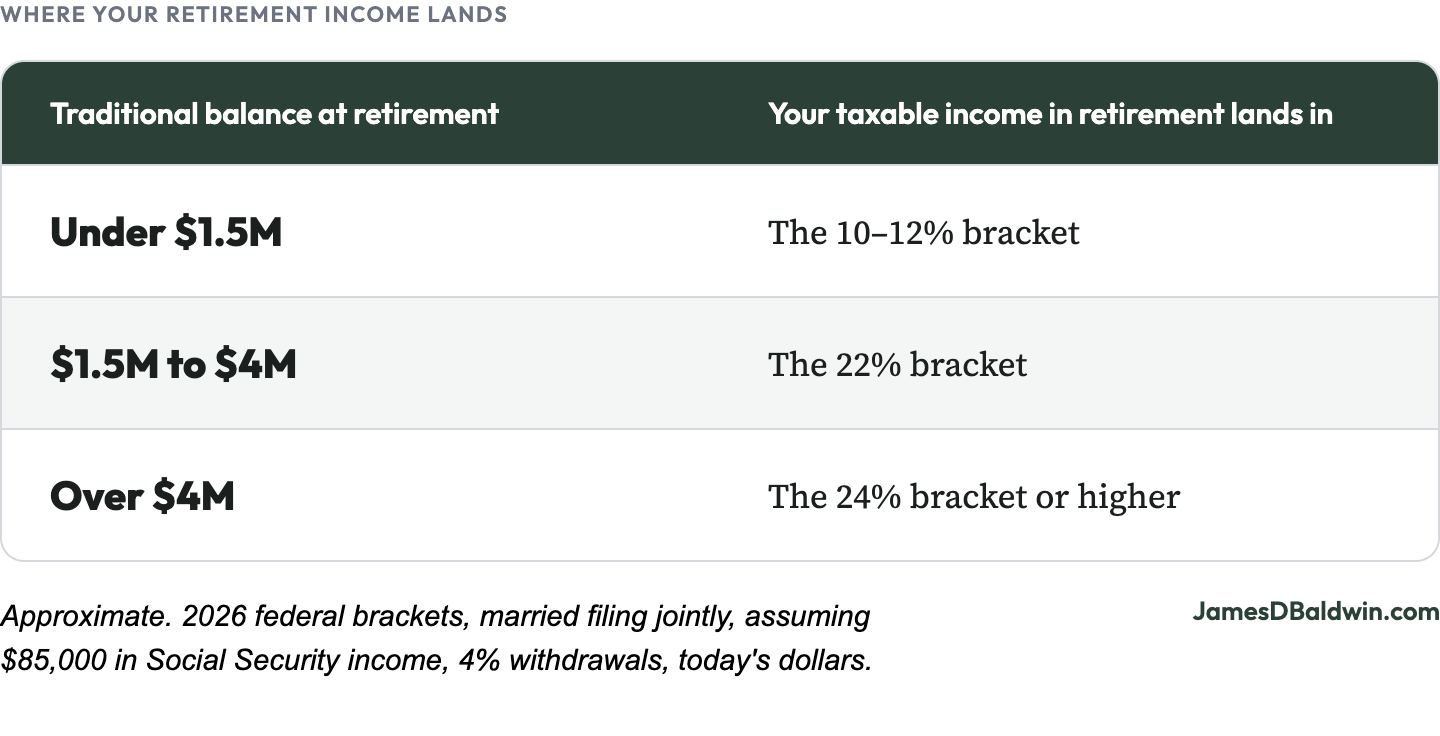
You can see how a Traditional balance on track to exceed $1.5M can push you out of the 12% tax bracket.
That happens to coincide with a big jump in the tax rates from 12% to 22%. That’s a 10-point jump. The next jump, from 22% to 24%, is much smaller. Then there’s another big jump from 24% to 32%, or 8 points.
That makes the 22% bracket particularly important. If you’re in the 22% or 24% bracket today and you expect to have $1.5M+ in Traditional balance, then you’re likely to withdraw those funds while in the 22% bracket in retirement. That saves you little or nothing.
The goal of Traditional accounts is to save taxes now, betting your tax rates will be lower later. But that doesn’t happen in this case.
That’s a case where some amount of Roth contribution can make sense. By switching more of your contribution to Roth, you can keep your Traditional balance from growing into that bracket.
The other benefit of splitting in this scenario is if Congress raises tax rates. Because the 22% and 24% brackets are only 2 points apart, even a slight tax increase can wipe out the whole benefit of Traditional. Biasing slightly toward Roth if you’re in the 24% bracket hedges this risk.
How to find your situation
To find which makes sense, match your income today (left) with your expected taxable income in retirement (top).
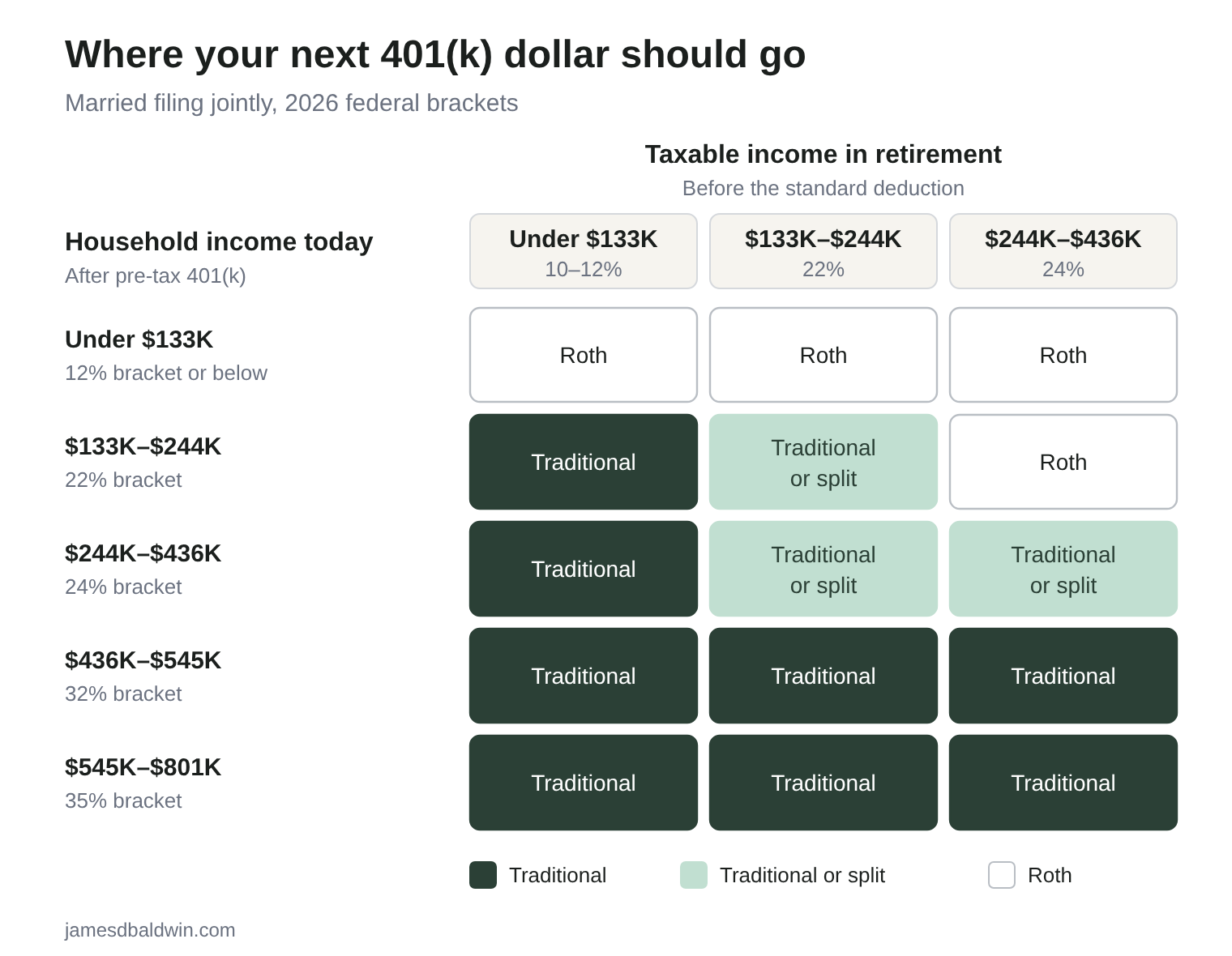
In some cases, the call is clear. However, you’ll notice that the 22-24% bracket contains some situations which say “Traditional or split.” For those, this calculator can quickly tell you which option makes sense for your specific numbers and how much to split into each (the best answer is rarely a 50/50 split). It also captures most state taxes which can change the equation.
The verdict
For most readers mid-career, the best default is a Traditional 401(k) plus a backdoor Roth IRA. Use Roth contributions or conversions strategically in your low-income years. That gets you to retirement with a significant amount in both accounts while minimizing taxes and having some hedge against future tax increases.
Splitting your 401(k) is only worth checking if you’re in the 22% or 24% bracket and on track for more than $1.5 million in Traditional savings.
How to dodge more taxes with a Traditional 401k.

I regularly see people paying $8,000+ more in taxes each year than they need to, especially those earning good money or who live in high-tax states.
Are you splitting your 401(k) today? Tell me what made you choose it. I’m curious how many of you set it once and never looked again.