

When people come to me for help, often the biggest question on their mind is, “What should I be investing in?”
But nine times out of ten, investing isn’t their problem. Their investment strategy is often pretty solid.
What they actually need is to look for places their wealth is leaking out of an otherwise solid plan.
These are the places where they’re losing large amounts of money to taxes, fees, and missed opportunities. A smart strategy can save them $100,000+, money that can be reinvested.
These are the most common areas dragging wealth down that I see when helping people who are earning six-figures.
Paying an advisor 1% for what a flat fee could cover
Potential Cost: $1M+ | Frequency: Common
The wealth drag of 1% advisor fees has been written about by many others and I’m sure most of you know the high costs already.
I still couldn’t leave it off the list because I keep seeing people, particularly as they become more successful in their careers, think that a money manager becomes necessary.
Picture this person: we’ll call him Jake. Jake gets a new job that comes with a big raise and a fancier title. He shares the news at a family dinner, and his in-laws convince him that he’s reached a new stage in life and now he needs a financial advisor.
So Jake hires an advisor and pays them 1% a year. The advisor was very helpful at the beginning. They set up his plan and directed his money to a set of investments.
And then what? The advisor rebalances and gives him a call a few times a year. They are getting paid to do something that a target-date fund could do for him for essentially free.
It’s not that the advice isn’t valuable. It’s that he’s vastly overpaying.
On a $500k portfolio with regular contributions, you would have paid $860,000 and lost $1.9M in wealth gains after 30 years of paying an advisor. That’s the price of a nice house.
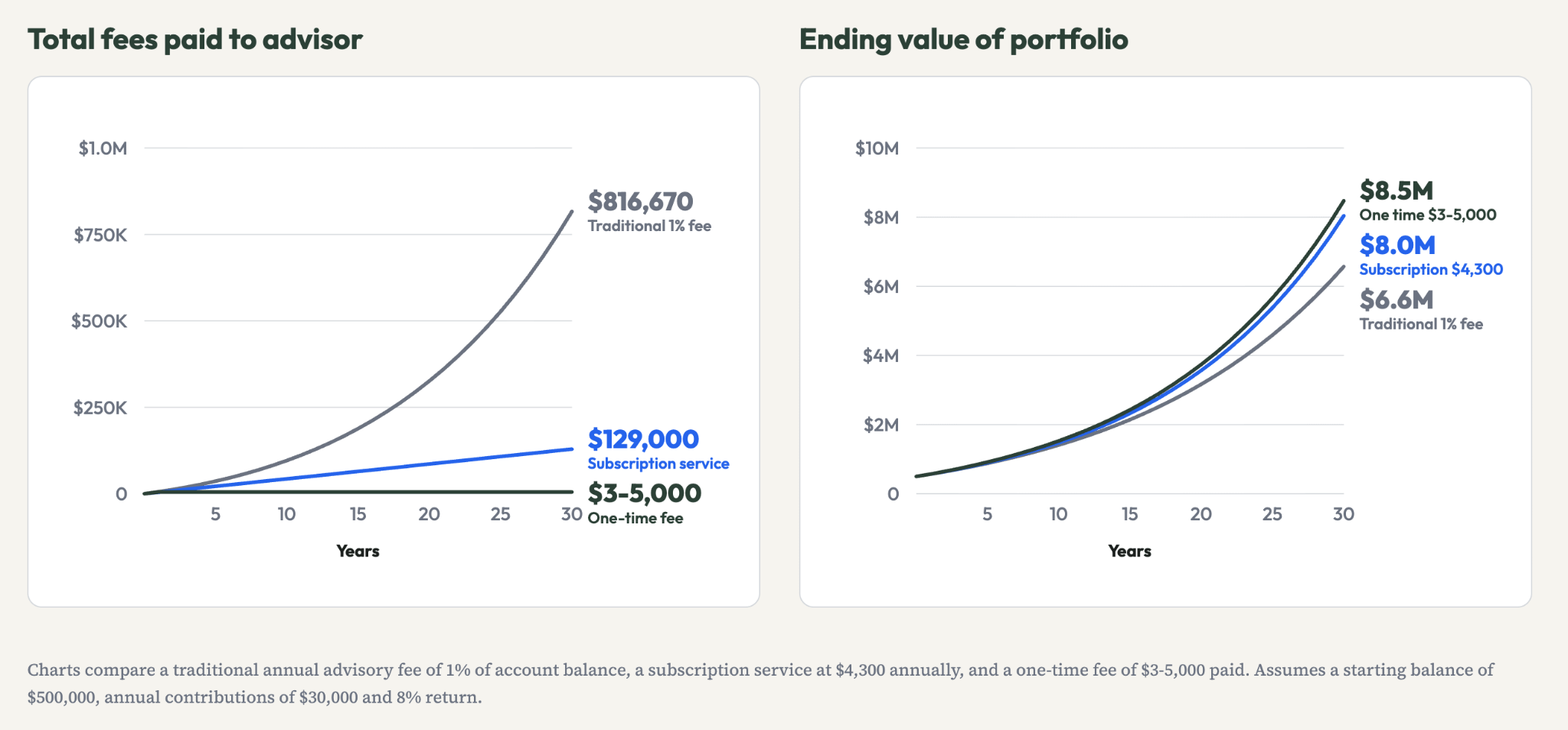
Instead, you could have hired a flat-fee advisor for a fraction of that.
I hear things like, “Oh, it’s too important to get wrong.” That’s very true! It is absolutely a good investment for everyone to get some tax planning and financial coaching on a regular basis. The money you earn from that work far outweighs the costs most of the time. But only if you are paying a reasonable fee. 1% is not reasonable.
Putting the right investments in the wrong place
Potential Cost: $250k+ | Frequency: Common
The more you earn and invest, the more taxes become the biggest drag on your portfolio.
When you’re in the early stages of investing, the numbers are often small enough that optimizing for taxes doesn’t seem to make much difference.
However, that becomes a problem as your income grows and you get into higher tax brackets.
There are a couple of mistakes I see people make here.
One is getting the tax location wrong.
The general rules of tax location are:
Roth accounts: Keep the highest expected return investments.
Traditional accounts: Keep investments that produce high ordinary income, like corporate bonds and REITs.
Taxable accounts: Keep tax-efficient investments here, like stock market index funds.
On a $1.5M portfolio with $300K of tax-inefficient bonds sitting in the wrong account, that avoidable drag compounds to roughly $220,000 to $330,000 over 20 to 25 years.
The second mistake I see here is where people keep their cash.
People often default to a high-yield savings account. However, municipal and Treasury money market funds can give you much better after-tax returns than a savings account, especially in a higher tax bracket.
This is a place where understanding the fundamentals, or getting some support from an expert, can help you save a lot of money with a few simple changes.
The catch is that you need to do it early, before your investments grow too large and moving the money to the right place causes its own tax headaches.
Not checking whether your 401(k) allows a Mega Backdoor Roth
Potential Cost: $250k+ | Frequency: Situational
This is a great opportunity too few people even know is possible. It allows you to shelter massive amounts of money from future taxes.
If your 401(k) plan has the right features, you can contribute up to $47,500 more to a Roth through the mega backdoor on top of maxing out your normal 401(k) contributions.
At a 30% marginal tax rate, that’s saving $14,000/year when you withdraw (plus tax-free interest too!)
I’ve seen people with upper-middle-class incomes where this is worth hundreds of thousands of dollars for them over the years.
The catch is that it’s not available on all 401(k) plans.
The most important thing you can do is check that it’s available. The easiest way is to email HR asking: “Does our 401(k) plan support after-tax contributions and in-service withdrawals?” If they say yes to both, you can do it.
Believing you need private equity and alternatives
Potential Cost: $250k+ | Frequency: Common
There is an allure to private equity investments.
Partly it’s because they are only available for certain accredited investors. We want what we can’t have.
Plus, rich people are investing in them. If the rich are doing it and making it hard for the little guys to get in, then we think it must be something great.
When people finally become eligible and an investment opportunity comes along through a friend or a wealth manager, many people jump at it.
I confess I’ve fallen into this trap myself while experimenting with alternative investments.
In truth, it isn’t always a mistake. Individual deals vary enormously, and some people have made excellent private investments.
However, the data doesn’t favor private investments. They have lagged public markets as a whole.
Bain & Co. tracked private equity funds compared to public market equivalents for 10 years. Private equity returned 15.3% annually net of fees. That’s slightly less than 15.5% for the index.
It’s not dramatically less, but it’s a lot less attractive when you consider that your money is locked up for many years in private investments.
For those who’ve accumulated some wealth and are now thinking, “Maybe I need to do something different with my money?”
I have some good news. You don’t need private equity, just like you don’t need other alternatives like precious metals or real estate. A stock market strategy has generally performed as well or better than these options with much more liquidity.
That is why it is the plan of the world’s most famous investor, Warren Buffett. He has left specific instructions for his portfolio to be managed exclusively in simple index funds because he believes they will outperform private equity and actively managed funds into the future.
I’d only suggest considering PE if you are willing to actually evaluate individual deals and understand the market dynamics. It requires you to become a part-time professional investor, and even then, best practice is to keep it to a minority of your portfolio.
Letting RSUs or Options take over your portfolio
Potential Cost: $100k+ | Frequency: Situational
It’s not uncommon for vested shares of RSUs or stock options to pile up quarter after quarter.
I’ve seen several reasons for this.
Sometimes selling company stock feels wrong. It can feel like betting against your own company. Some companies have a culture of not selling. There can be pressure to hold, as if your stock ownership proves your commitment.
Others are excited about what the company is working on and truly believe in its potential for growth.
And others simply lose track of how much they’ve accumulated and don’t notice it has become a sizable part of their net worth.
This concentration, while not inherently bad, does expose you to some risk.
When things go wrong, a single bad year for your company stock can easily cost you more than a year of maxed-out 401(k) contributions.
It exposes you to the double risk of your company going through tough times. Your job is at risk, as well as your net worth.
For example, in the SaaS-pocalypse earlier this year, many big successful tech companies were hit hard. Many are still about 25% down, like Salesforce.
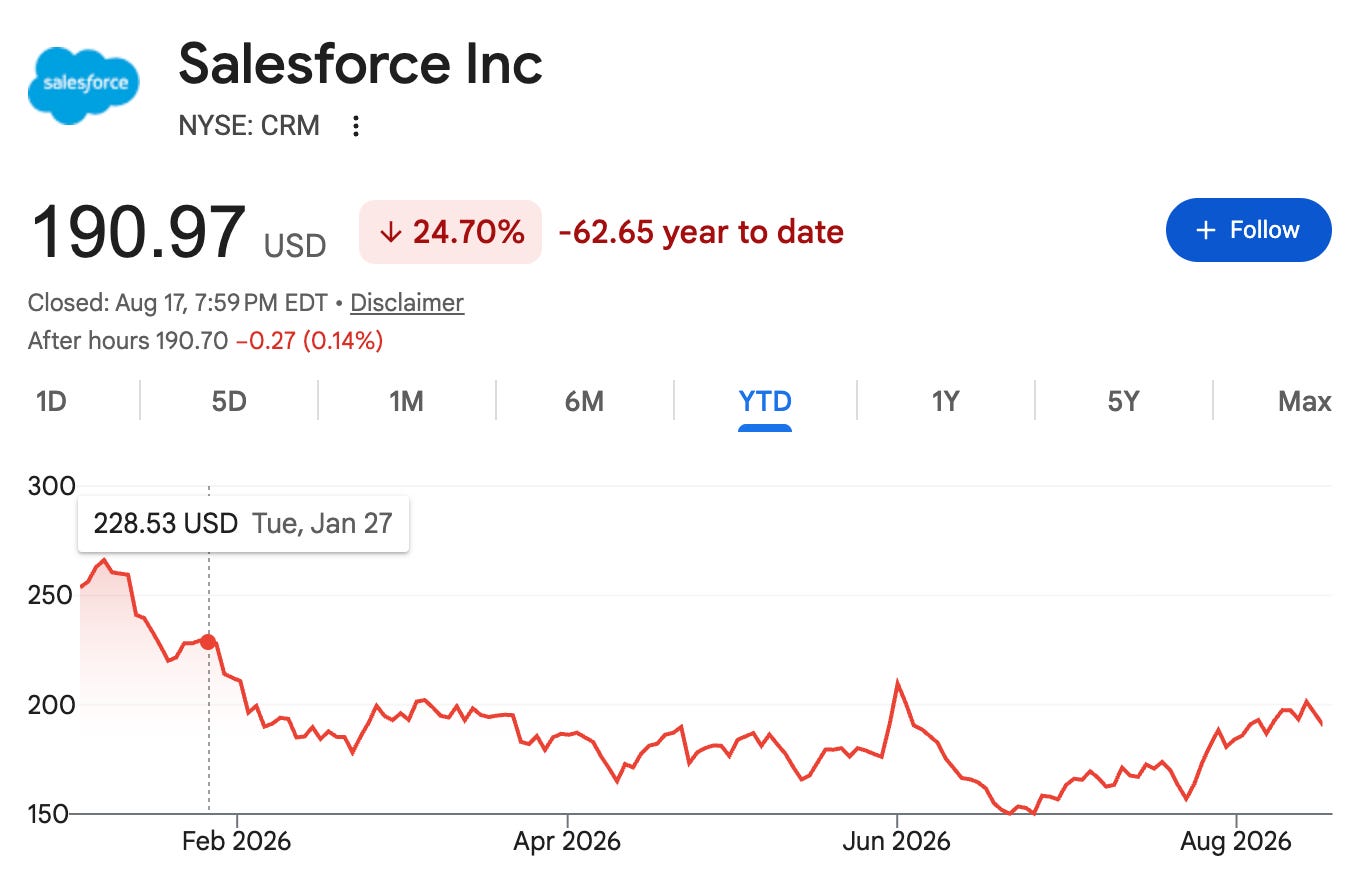
When one stock becomes a big part of a substantial portfolio, these kinds of declines can lead to $100,000+ losses.
If you are not sure if you are overexposed to your company’s stock, do this simple test: ask yourself, “If I didn’t work here, would I invest as much of my portfolio in this one stock?”
If the answer is no, set yourself a calendar reminder to sell your vested shares and move them to your diversified portfolio on a regular basis so you aren’t having to decide every time whether to sell or hold.
Sitting on cash while you wait to “figure it out”
Potential Cost: $50k+ | Frequency: Situational
Whether from a windfall like a bonus or inheritance, or simply months of unassigned savings, excess cash can build up in an account waiting for you to do something.
The larger the amount of money, the higher the stakes in deciding what to do. When that happens, people can hesitate. The money sits there, not earning very much.
People will tell themselves, “I’ll wait until we talk to an expert,“ or “I’m not sure if I’ll need it for something soon.”
Months or years pass and the money is still sitting there. They never found the time to do the research or find someone to help them.
Meanwhile, that cash earns next to nothing when it could be invested and growing.
On $100,000 sitting in a savings account earning 1% instead of invested at 8%, five years of delay costs about $40,000. After 10 years, it’s over $100,000.
This can be solved with a little planning ahead. Set a minimum and maximum goal for how much cash you want to keep for emergency purposes and upcoming big expenses. Then commit to investing the rest as you receive it.
These are situations that I’ve anonymized but pulled from real examples I’ve seen. And in some cases I’ve helped people who dealt with several of these issues at the same time.
You can easily prevent yourself from wasting tens or hundreds of thousands of dollars and put that money to work building wealth instead.
Take a moment today and do at least one of these things:
Estimate what you’re paying your advisor in dollars (not percentage).
Think about whether you want the risk and work that comes with private equity investing.
Check what types of assets you have in your taxable accounts vs. tax-advantaged accounts.
Email your HR: “Does our 401(k) plan support after-tax contributions and in-service withdrawals?”
Set a calendar reminder to sell your vested shares.
Decide on a cap for your cash and where you’ll invest any extra.
Did any of these apply to you? Let me know in the comments.
Disclaimer: This is for informational and educational purposes only and does not constitute financial, legal, or tax advice. Consult a professional before making major financial decisions.
Does it matter where you put your bonds?

Bonds have had a big news week. The 10-year Treasury yield hit 5.2%, its highest level in 19 years.