

Bonds have had a big news week. The 10-year Treasury yield hit 5.2%, its highest level in 19 years.
That has people worried about inflation and the economy. On the bright side, it also makes bonds a decent investment again.
It adds a wrinkle, though. Now that bonds pay real interest, the tax on that interest adds up.
So, should you worry about that tax, and is it worth moving money around to shelter your bonds from it?
What is “tax location”?
Asset allocation is your mix of investments, like stocks and bonds.
Tax location is which account holds each one.
Most default retirement portfolios, like target-date funds, ignore location and put the same mix in every account. That’s simple, and inside a 401(k) or Roth IRA it works.
But once you start investing outside of these tax-advantaged accounts, it starts to matter, because stocks and bonds are taxed differently.
Long-term stock gains and qualified dividends are taxed at 15% for most high earners, while bond interest is taxed at your full marginal income tax rate.
Each account treats that income differently, too. A taxable account pays tax every year. A Traditional 401(k) or IRA defers it until you withdraw. A Roth grows tax-free.
To pay the least tax, we can strategically use these 3 different types of accounts to shelter different investments, based on their relative advantages.
While there are a lot of variables that could affect your personal plan, there is a general strategy that’s good enough for most situations:
The general strategy
Put tax-inefficient investments like bonds, REITs and actively managed funds in your Traditional 401(k) first. Put high-growth investments like stocks in your Roth. Put tax-efficient investments like broad stock index funds in your taxable account.
With a simple stocks and bonds index strategy using funds like VTI and BND, that means:
Traditional: bonds (BND) first. If there’s room left, stocks.
Roth: stocks (VTI), plus any bonds that didn’t fit in Traditional.
Taxable: any remaining stocks (VTI).
What are the biggest taxes to worry about?
For most people, it’s bonds. The unsexy but important part of portfolios everywhere.
Bond interest in a taxable account is taxed every year at your marginal income tax rate. Here’s how much extra you’d pay each year to hold $10,000 or $50,000 of bonds in a taxable account instead of stocks.
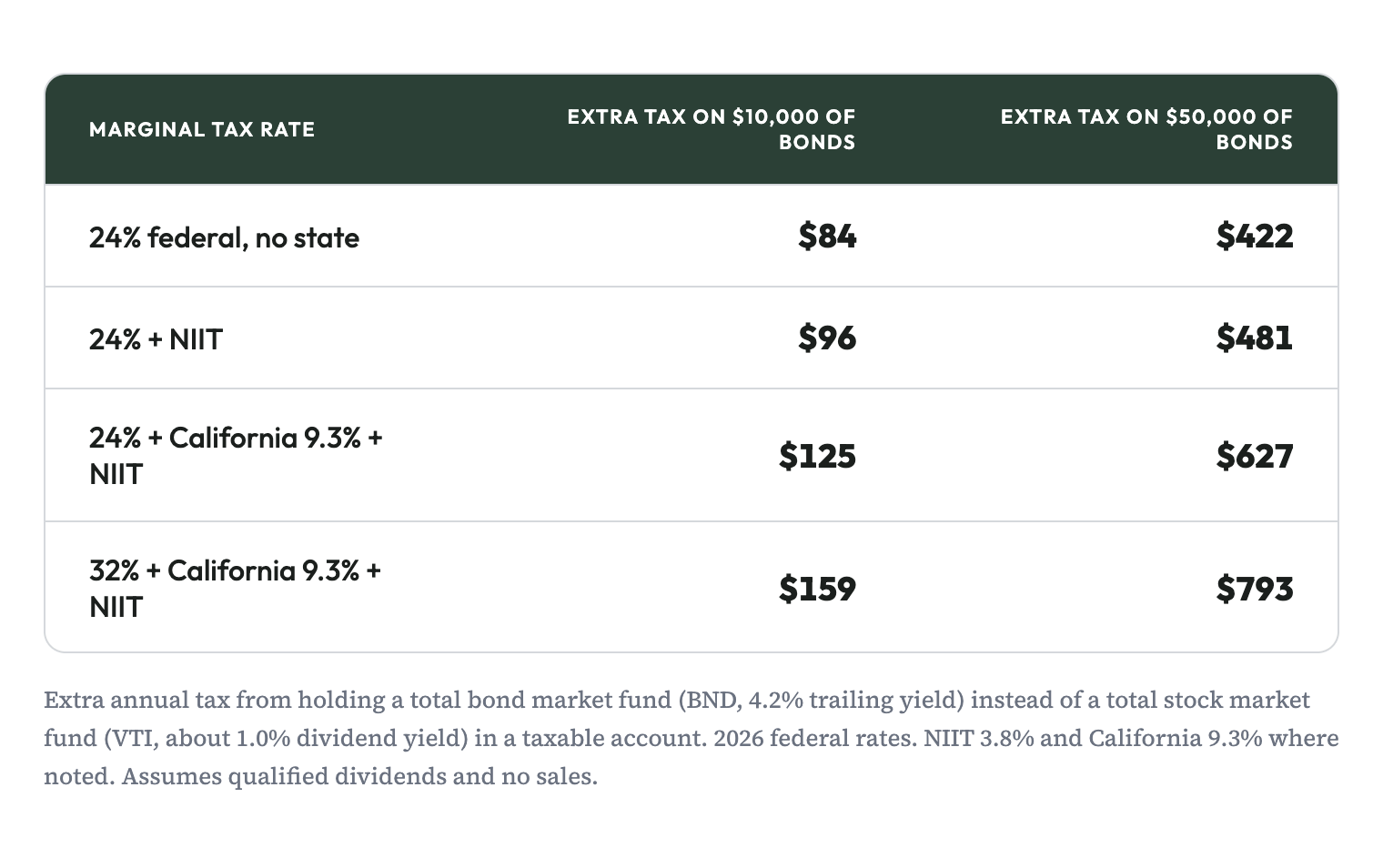
At $10,000, the cost isn’t worth much hassle. As your bond holdings grow, it becomes real money that can be reinvested each year. And the higher your bracket, the more it matters.
Other tax-inefficient investments
Bonds are the asset most people deal with, but not the only one. Anything that pays out more taxable income each year belongs in this category:
REITs: most of their dividends are taxed as ordinary income, so treat them like bonds.
Target-date funds: they hold bonds, so the same math applies. Funds dated sooner hold more bonds.
High-dividend funds: they’re designed to pay out more as income rather than appreciate in price as capital gains. Every dollar is taxed the year you receive it.
Actively managed funds and frequent trading: anything sold within a year is taxed at your marginal income tax rate, and active funds pass those gains along whether you sell or not.
An example with Mark and Elena. Interaction with their RMDs.
Let’s return to Mark and Elena from the required minimum distribution (RMD) post. They’re approaching 40 and want to hold a fairly standard 80/20 portfolio mix of stocks and bonds.
They currently have $30,000 of bonds in their taxable account. That costs them about $300 a year at their 24% tax bracket and current rates. That’s not much yet, but it will keep growing as their bonds do.
Mark and Elena want to minimize lifetime taxes. The bigger issue for them is the long-term RMD problem we covered last post. They’re on track to build a large balance in their Traditional accounts.
By implementing a tax location strategy, they move their lower-growth bonds into Traditional accounts. This lowers their tax bill and has a second benefit. It slows growth in their Traditional account. That will lower their RMD tax burden later in life.
Meanwhile, they started contributing to a Roth account that is growing faster. That money is tax-free forever with no RMDs.
With a little bit of planning, they saved themselves tens of thousands of dollars in taxes later.
The Verdict: Is it worth it for you?
Tax location strategy is worth implementing if either of these is true.
1. You hold ~$50,000 or more of bonds or REITs in a taxable account. That includes the bonds inside target-date and balanced funds. If you hold 80/20 everywhere, that’s a taxable account of about $250,000. At that level, moving them into a retirement account saves roughly $400 to $800 a year. People in higher tax brackets will get more benefit and want to do this sooner.
2. You expect more than $1.5 million in Traditional accounts by the time RMDs start because of the tax-torpedo effect of large required minimum distributions (RMDs). This one applies even if you have no taxable account at all.
If either one fits, implement a tax location strategy. If you hold a lot of tax-inefficient investments, it’s worth a deeper look at your situation with a professional.
How do I fix it without a tax bill?
Firstly, think about all of your accounts as one portfolio with one target mix.
You can make trades inside your 401(k) and IRAs without being taxed, so shifting bonds into your 401(k) and stocks into your Roth is free.
In taxable accounts, avoid selling anything with a gain, since you’ll owe capital gains tax on it.
Instead, point new money and dividends at stock index funds, and let the mix shift over time.
The bottom line
Today’s higher bond yields make these strategies more important. But if neither test criteria apply, your simple setup is fine.
For Mark and Elena, moving bonds into their Traditional 401(k) is a start on their RMD problem.
Where you hold your bonds won’t make you rich. Getting it wrong just costs you a little bit more money every year that you could be putting to work instead.
Is your 401(k) big enough to cause an RMD problem yet?

“Traditional retirement accounts are better than Roth the more you earn.” I’ve given that advice myself, and as a general rule, it still holds. You get the deduction now, at your highest marginal rate, and pay the tax later, in retirement, when your rate is usually lower.
Do a Backdoor Roth IRA the Right Way

Here’s a finance secret. It’s easy to pay $0 federal income tax in retirement. Even spending $150k+ per year. It all starts with a word: Roth.