

The beauty of the 4% rule is in its simplicity.
The rule says you can use 4% of your portfolio every year, and have it last over a 30-year retirement.
Personal finance is a world with too many spreadsheets and calculations. This is the exception. All you need is a napkin and fifth-grade math to figure it out, which is why I like it.
But nearly everyone who talks about the 4% rule glosses over a key problem.
Most people talk about the 4% rule as how much you can spend. But it actually tells you how much you can withdraw.
The problem is that, while you can withdraw the 4%, you then pay tax on it, and only spend what’s left.
The problem is that the 4% rule ignores the haircut taxes take on your lifestyle.
Think in terms of take-home wealth
Of course, this is the same issue you deal with every paycheck. Your monthly salary is different from your take-home pay.
A portfolio works the same way.
Portfolio − Future Taxes = Take-home Wealth
Although there is one major difference here with the paycheck analogy.
We have much more control over our portfolio taxes.
If you read Your Money Has Five Jobs, this is the third job: Keep it.
Feeding and growing your money builds the pile, and keeping it sets how much of the pile you get to use to retire sooner, upgrade your vacations, give generously or whatever matters to you.
Case study: When the 4% rule breaks
Let’s go back to Mark and Elena who we’ve been tracking recently.
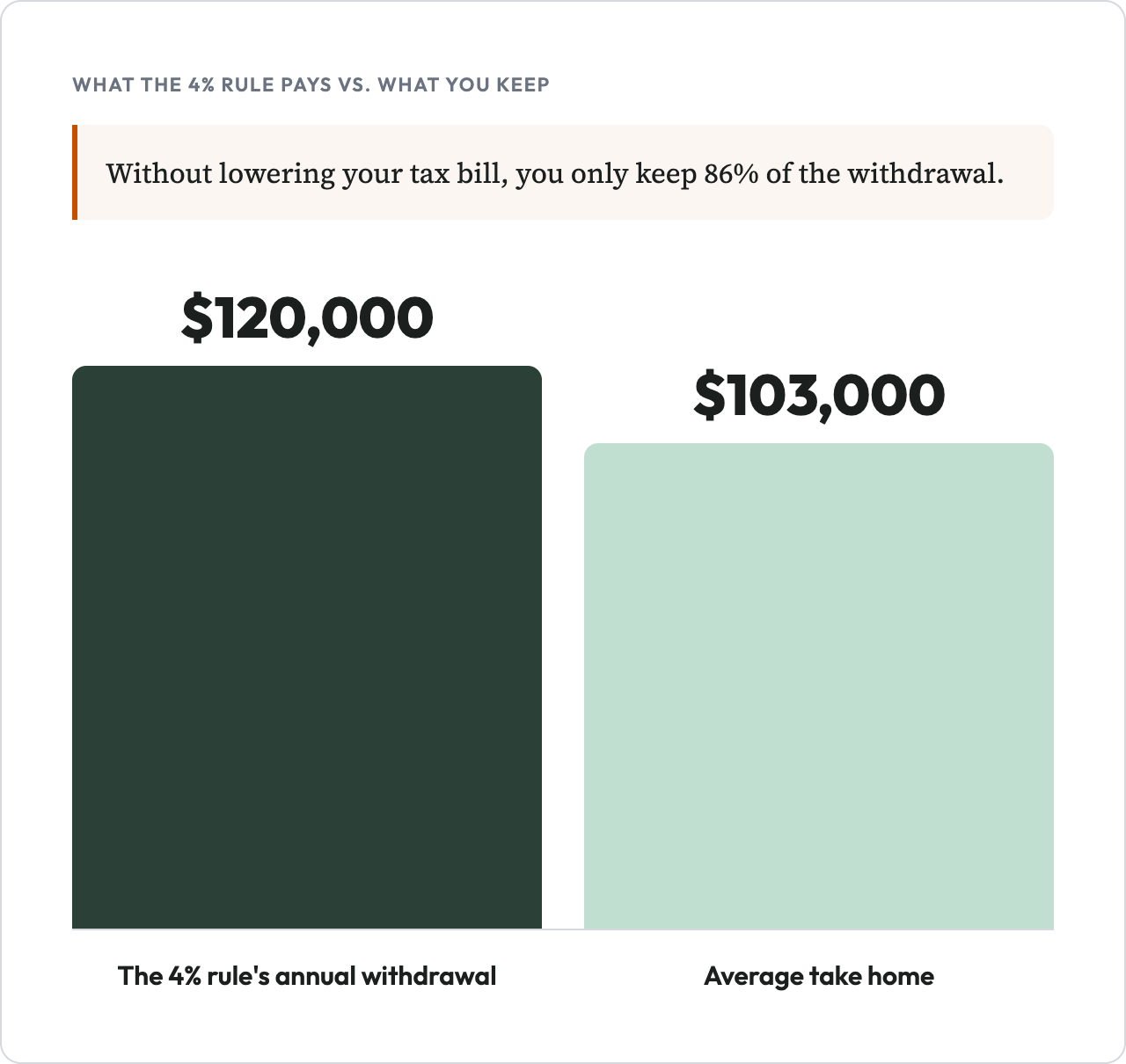
They have decided they want to retire and be able to spend $120,000 a year.
They read about the 4% rule, and calculate they need to save $3M. ($3M x 4% = $120k)
So they diligently save and invest until they retire at 65. That $120,000 is their whole retirement living expenses. Once Social Security starts at 70, it covers most of it, and the portfolio covers the rest.
But they didn’t think about the taxes.
They pay income tax, capital gains tax, and have to deal with Required Minimum Distributions.
Averaged across retirement, taxes cost 14 cents of every dollar, and they keep 86 cents of their withdrawals.
How to make the 4% rule work again
If Mark and Elena were counting on the 4% rule funding their spending goal of $120,000 they are now very disappointed to live on $103,000.
So why does everyone continue to conflate the 4% withdrawal with future spending? Are they all wrong? Not necessarily.
The rule is still useful for two reasons.
It’s intentionally a major simplification. It’s designed to get you to a rough number. It should never be your whole financial plan.
If you can figure out how to pay very little tax, then annual withdrawals and spending become nearly the same and the 4% rule works as designed!
Paying very little tax is more possible than you might think. We’ve spent the last few articles exploring how to do just that.
For example, in the Roth conversion post, Mark and Elena figured out a plan to use the years when they were in a low tax bracket to convert part of their Traditional accounts to Roth. This dramatically lowers their lifetime tax bill. Averaged across retirement, that allows them to keep about 93 cents of every dollar (up from 86¢)
If they retired earlier at 55-60 (which they can), they would do even better by having more time to do low-cost conversions. They would keep about 96 cents of every dollar.
The Verdict
The 4% rule is still a good savings target, as long as you understand that it simplifies out tax and have a strategy to reduce your taxes.
Roth conversions are just one tax strategy. There are others. And many of them are decisions you make in your working years, not when you retire. Strategies like:
Choosing Roth vs. Traditional
Deciding where to hold each investment
Taking advantage of the 0% capital gains tax bracket
Harvesting Tax losses or gains.
As a simple adjustment you can also reduce the 4%. The ‘After-tax rule’ would be the ~3.6% rule.
Running the full numbers for your situation will tell you if you can withdraw even more. This is a place where it can also pay to get help from a professional.
With good tax planning, your withdrawals and your spending get close to the same number, and the 4% rule works as intended.
PS. How low can your taxes in retirement go? I’ll take Mark and Elena as far as they can get in a coming post.
How to use Roth conversions to lower your tax bill.

In this post last month, I explained why a Traditional 401(k) is still usually the right call for high earners, even when RMDs could pose a tax problem later.
What’s your rough split between Traditional, Roth and taxable? Reply in the comments. I’m interested how many of you are mostly Traditional vs. mostly Roth.