

There are too many fear tactics around taxes in retirement. The pitch goes like this: why risk paying high taxes later? Pay them now and put everything in a tax-free Roth.
Run the numbers, though, and you’ll find there are better ways to keep your taxes low.
Take Mark and Elena, the couple in their 40s we’ve been following for several posts. They can retire, spend $125,000 to $175,000 a year and pay $0 in federal income tax for their first 15 years.
It’s not a loophole or a contrived example. Many people can do the same using the tax code to their advantage.
And it matters now, while they’re still years from retirement. It helps them understand that they don’t need to default to a Roth 401(k) just to avoid taxes later.
Where tax-free income comes from
Not all retirement income is taxed the same way. Some of it is never federally taxed. Some of it is tax-free up to a limit each year.
Always tax-free
Roth IRA withdrawals. Withdrawals are tax-free after 59½. And your original contributions can come out anytime.
Cost basis in a taxable account. When you sell, only the gain is taxed. What you originally invested is called your “cost basis” and is tax-free. If half the value is basis, half of every sale is your own money coming back.
HSA withdrawals for medical costs, including Medicare premiums.
Municipal bond interest. It’s not taxed federally, although it does count toward how much of your Social Security gets taxed.
Gain on selling your home, up to $500,000 for a married couple.
Tax-free up to a limit each year
These reset every January, and any room you don’t use each year is lost.
401(k) withdrawals up to the standard deduction. For a married couple in 2027, that’s $33,200. Roth conversions count here too.
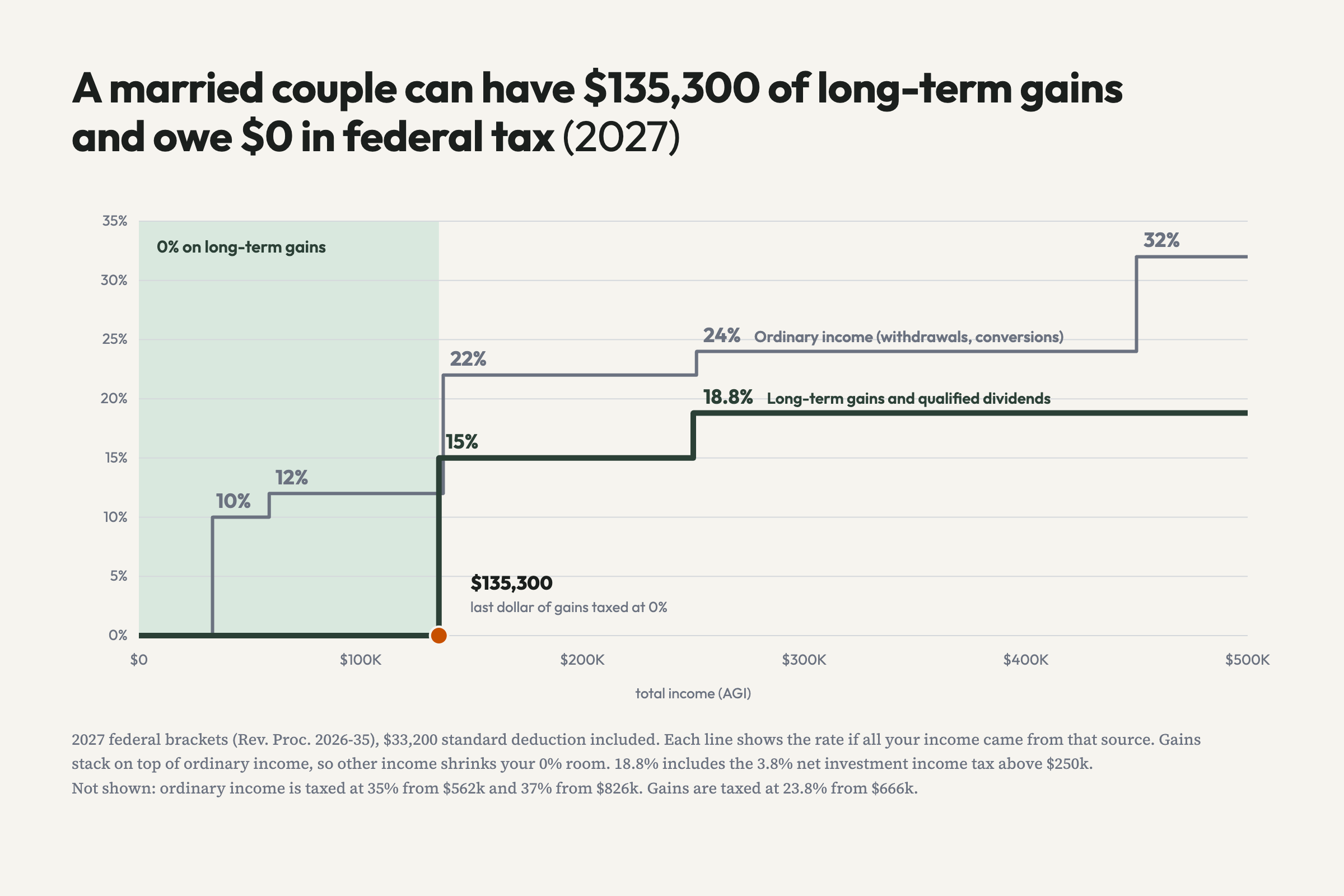
Long-term capital gains and qualified dividends in the 0% bracket. A married couple can have up to $135,300 of total income, including the standard deduction, before any gains are taxed.
Capital gains stack on top of other income, including 401(k) withdrawals, so the two limits share the standard deduction. You could do a $33,200 conversion plus $102,100 of capital gains, for a combined total of $135,300, all tax-free.
Mark and Elena at $125,000
Let’s return to Mark and Elena and see how they can take advantage of tax-free income opportunities.
They’re mid-40s and want to retire on the early side and spend $125,000 a year. They’re on track to retire at 60 with:
$1 million in 401(k)s
$1.5 million in a taxable account (half of it gains)
$500,000 in Roth IRA
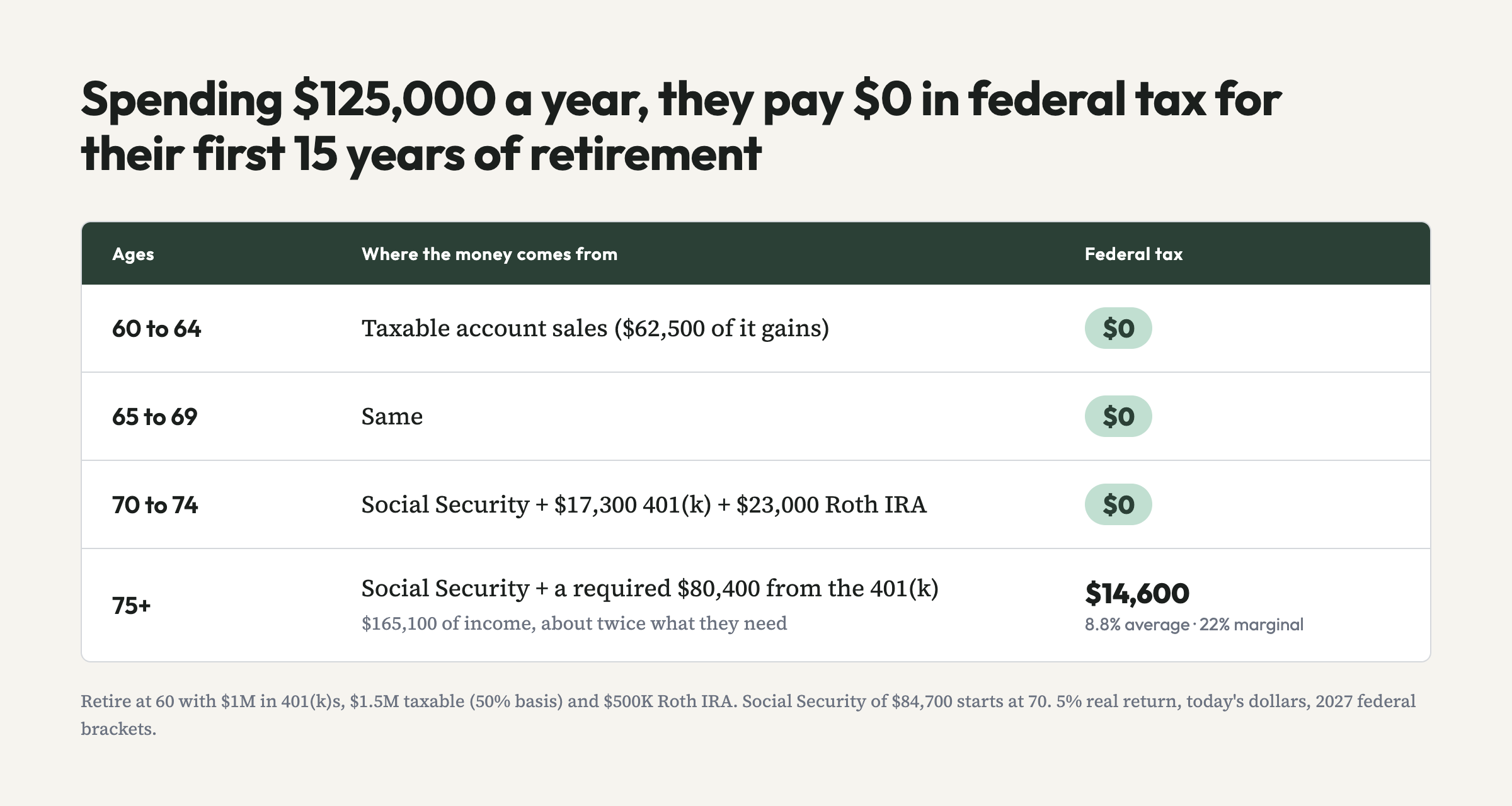
They can fairly easily pay $0 in tax for their first 15 years of retirement.
From 60 to 69, they live off the taxable account. Half of every sale is basis, so only $62,500 a year is gain, and it fits under the 0% line.
At 70, they start taking Social Security and it covers most of their spending. On top of it, they can take about $17,300 a year from their 401(k) and still owe nothing. Their Roth IRA covers the rest.
At 75, required minimum distributions start. The IRS makes them take about $80,400 from their 401(k)s, roughly twice what they need. That’s where the tax bill comes back.
And their situation doesn’t factor in other tax-free options like an HSA or municipal bonds, which could add even more tax-free income.
What if they want to spend $175,000?
What if Mark and Elena want to spend more, to upgrade their travel or their lifestyle? Let’s look at another scenario where they spend $175,000 a year.
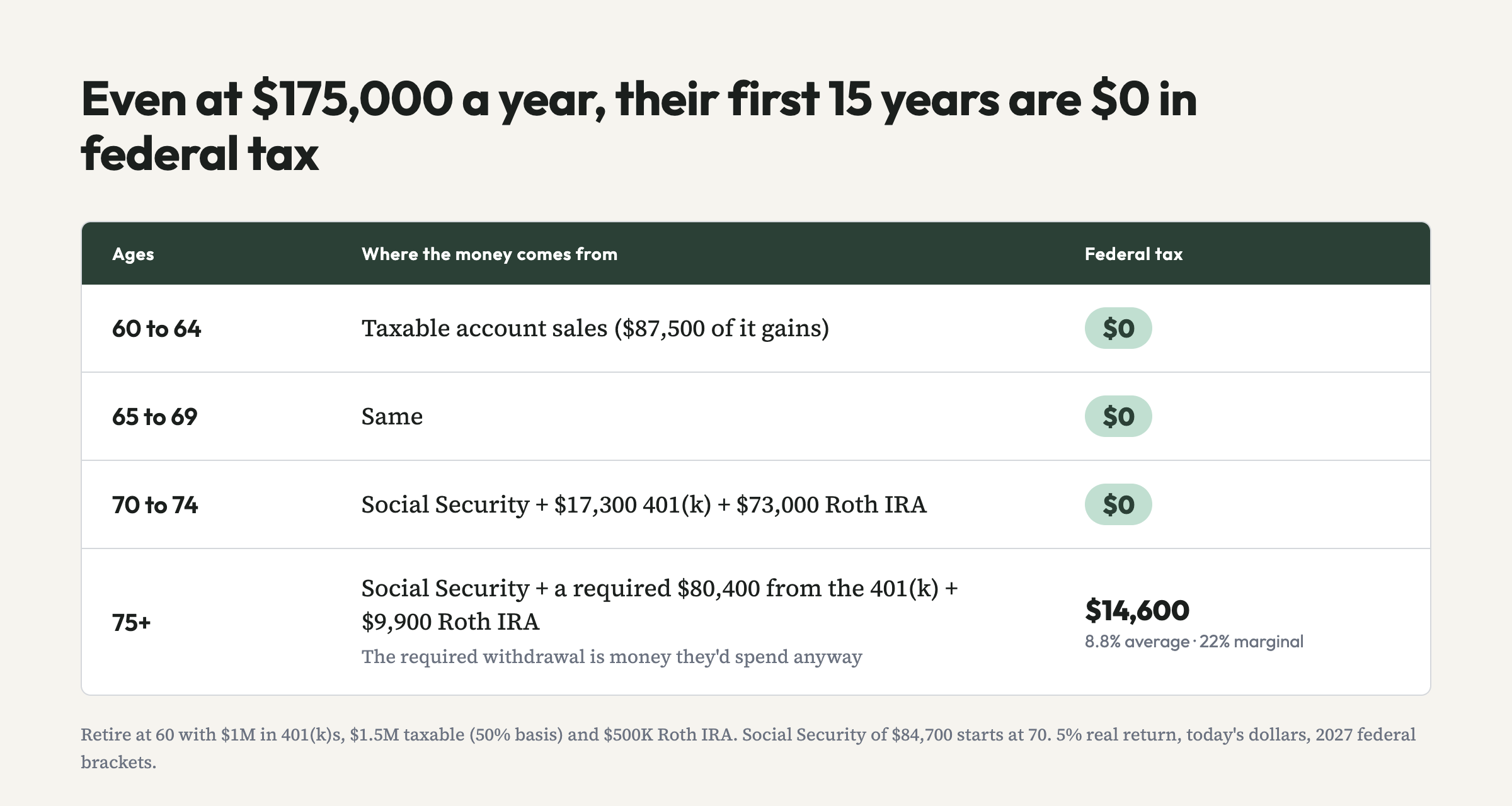
They find that they can still pay $0 for their first 15 years.
They start with the taxable account, selling $175,000 a year. Half of that is their original investment, so only $87,500 is gain, and that still fits under the 0% capital gains bracket.
At this spending level, the required distribution at 75 is money they want to spend anyway rather than forced extra withdrawals.
$0 is great, but it isn’t the goal
Mark and Elena aren’t a contrived example built to hit $0. They’re diligent savers with a mix of accounts like many people have. If you’re like them and have some 401(k), some Roth IRA and some taxable money, you could choose to pay $0 for at least part of your retirement.
But $0 in federal taxes isn’t the goal.
The better goal is the most wealth over your lifetime, and sometimes that means strategically paying some tax.
From age 60 to 69, Mark and Elena’s 10% and 12% brackets sit empty. If they fill them with 401(k) withdrawals and Roth conversions, they pay about $11,000 a year in tax. That completely avoids the required minimum distributions problem that would otherwise push them into the 22% bracket.
This updated strategy cuts their lifetime tax bill by about $400,000 and they pay lower marginal tax rates through their retirement (12%) than while working (24%+).
Why this matters now, while you’re still saving
Understanding these tools changes how you think about Roth vs. Traditional 401(k) while you’re still working.
Once you know you can choose when to pay tax, and take advantage of lower brackets, Roth no longer has to be the fear-based default.
If you’re mid-career and in your peak earning years, a Traditional 401(k) is usually the better choice. If you’re worried rates will rise, holding both is a cheaper hedge than going all Roth.
Then the plan is to decide when you pay the tax. For most people, that’s the early years of retirement, before required minimum distributions start.
The verdict
With a mix of accounts, $0 in federal income tax for your first 15 years of retirement is highly achievable, even at $175,000 a year. Required distributions bring the bill back at about 9% of income.
While $0 in taxes is an option for many people, you can become even wealthier by using your low-tax years to fill the bottom brackets. That brings your lifetime bill very low, though not quite zero.
Paying 24% or more today for Roth to avoid about 12% later is the worse trade. It’s like paying a quarter today to save a dime in 20 years.
Coming up: As you can see, I’m a big fan of the Traditional 401(k) mid-career. I also like building a Roth IRA alongside it. In my next post, I’ll show you how to do a backdoor Roth IRA the right way, before December 31.
Question: Do you expect to pay more or less tax in retirement than you do now? Tell me why in the comments.
Is your 401(k) big enough to cause an RMD problem yet?

“Traditional retirement accounts are better than Roth the more you earn.” I’ve given that advice myself, and as a general rule, it still holds. You get the deduction now, at your highest marginal rate, and pay the tax later, in retirement, when your rate is usually lower.
Disclaimer: This is for informational and educational purposes only and does not constitute financial, legal, or tax advice. Consult a professional before making major financial decisions.